
Ask a factory manager whether their business produces hazardous waste and you will get a sensible answer, because the drums are labelled and the paperwork is filed. Ask the same question in an office, a salon, a school, or a shop, and you will usually get a confident no.
That no is almost always wrong.
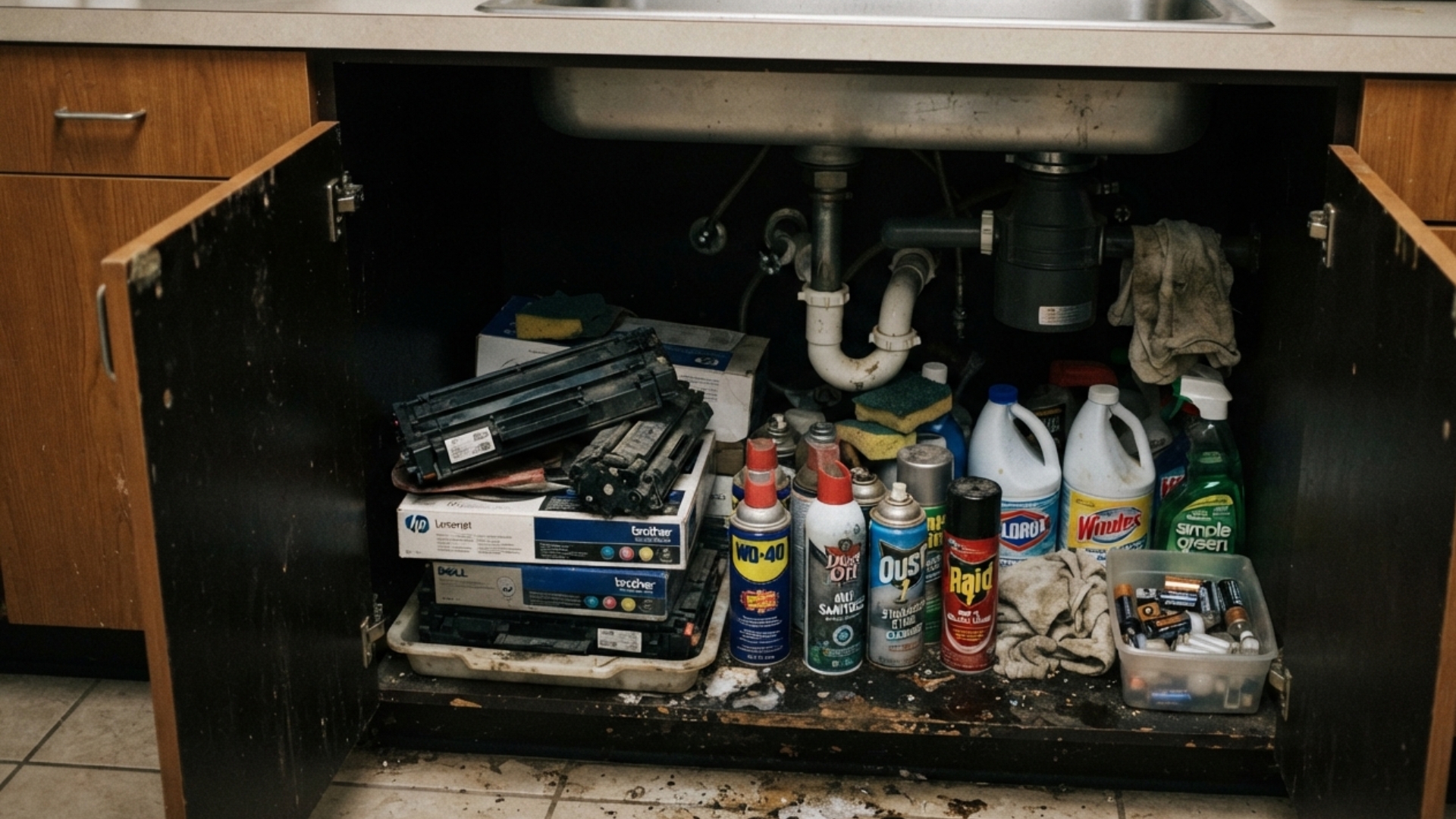
Walk the average workplace with a trained eye and the hazardous waste reveals itself everywhere: the dead fluorescent tubes above the stockroom, the toner cartridges in the print room, the aerosol polish under reception, the battery drawer nobody empties, the cupboard of cleaning chemicals, the half-tin of gloss from the last refurbishment. Every one of them is classified hazardous waste, and every one carries legal obligations that a general waste bin does not satisfy.
Here is the guided tour of the hazardous waste hiding in ordinary businesses, why it matters, and the genuinely painless way small producers stay compliant.
The Usual Suspects, Room By Room
The print room and office. Toner and ink cartridges carry hazardous classifications, and so do the aerosol dusters beside them. The IT cupboard adds batteries of every chemistry, from AAs to lithium packs, plus old UPS units. Batteries deserve particular respect: lithium cells crushed in general waste vehicles are now one of the industry’s leading fire causes.
The lighting. Fluorescent tubes and many older lamps contain mercury. They are hazardous whole, and considerably more so once shattered in a compactor. Our tube and bulb recycling service exists precisely because these fail constantly and accumulate in every workplace ceiling.
The cleaning cupboard. Bleaches, descalers, oven cleaners, disinfectants, and their concentrated catering cousins carry corrosive and irritant classifications. Part-used bottles at clearout time are hazardous waste, not sink material; pouring them away is a pollution offence with your business’s name on it.
The maintenance corner. Paints, thinners, adhesives, sealants, lubricants, oily rags, and aerosols of every kind. Oily rags surprise people: soaked textiles are classified hazardous and, left piled, are a self-heating fire risk in their own right.
The kitchen and welfare areas. The fridge itself, at end of life, is hazardous waste thanks to its refrigerant gases and blowing agents; fridge and freezer recycling is a dedicated route for a reason.
And the empties. The counterintuitive one: containers are classified by what they held. The “empty” solvent drum, the drained paint tin, the spent aerosol all retain residues, and all belong in the hazardous stream unless properly decontaminated. Even the puncture-resistant instinct is wrong: an aerosol pierced in a bin bag is a small bomb that has simply not been introduced to a spark yet.
The Label Trick: Let The Pictograms Do The Work
Nobody in a normal business needs to memorise waste classifications, because the products announce themselves. Check labels for the diamond hazard pictograms: the flame, the exclamation mark, the corrosion symbol, the skull, the health hazard silhouette, the dead-fish environment mark.
The operating rule is beautifully simple: if it carried a warning diamond when it was bought, its remains, and usually its container, are hazardous waste when it is thrown. Teach that one sentence to whoever manages your bins and the identification problem largely solves itself.
The remaining puzzles, unlabelled bottles, mystery drums, inherited stock from the previous tenant, are what analysis is for. It is illegal to transport hazardous chemicals nobody can identify, which is why our in-house chemists sample and analyse unknowns before quoting their disposal. Guessing is not a compliance strategy, and it is certainly not a transport one.
Why The General Bin Is Not An Option
The rules are not decorative. Hazardous waste must be kept separate from general waste, stored safely in suitable containers, and moved only by authorised carriers to permitted facilities, with each movement recorded on a consignment note your business keeps for at least three years. Our consignment note guide walks through that paperwork in plain English.
Enforcement aside, and the Environment Agency does enforce, there are two practical reasons the rules deserve respect.
First, the risks are real rather than theoretical. Mercury from a bin of crushed tubes, lithium fires in collection vehicles, mixed chemical reactions in compactors: the waste industry’s incident log is a catalogue of ordinary items in the wrong stream.
Second, detection is routine now. Collectors inspect, transfer stations reject, and a load bounced for contamination comes back as surcharges and awkward questions. The era of the blind eye is over, quietly but completely.
The Small Producer’s Answer: The Haz Box
Here is where most non-industrial businesses breathe out. The volumes above are typically small: a few tubes, a drawer of batteries, some aerosols and part-tins a year. What small producers need is not drum logistics; it is a compliant home for small quantities, and that is exactly what a Haz Box service provides.
A UN-approved container lives on your site. The odds and ends of workplace hazardous waste, aerosols, batteries, cartridges, small chemicals, go in as they arise. When it is full, it is collected, replaced, and fully documented, consignment paperwork included. Compliance becomes a piece of furniture, as our Haz Box guide explains in detail.
Larger or more specific streams get their own routes: paint in volume, waste oils, laboratory chemicals, asbestos, agrochemicals from farm stores, each covered elsewhere on this blog and each collected mainland UK-wide, as far north as Glasgow and Edinburgh, typically within 5 to 7 working days on a date we commit to in advance.
Frequently Asked Questions About Workplace Hazardous Waste
What are the most common examples in a workplace?
Aerosols, toner, batteries, fluorescent tubes, cleaning chemicals, paints, adhesives, oils, oily rags, solvents, fridges, and the empty containers of all of the above. Nearly every business produces several.
Can hazardous waste go in the normal business bin?
No. It must be segregated, stored safely, and moved by an authorised carrier under a consignment note. Mixed loads increasingly get rejected, surcharged, and reported.
How do I know if something qualifies?
The label tells you: any hazard diamond when purchased means hazardous when discarded. Unlabelled unknowns need chemical analysis before anyone may lawfully transport them.
Are empty containers really hazardous?
Usually. Residues classify the container, so the drained tin and the spent aerosol travel the hazardous route. Never pierce aerosols to make them safe; that manufactures the danger.
What is the easiest route for small quantities?
A Haz Box: UN-approved container on site, filled gradually, collected and documented when full. Small-producer compliance without industrial logistics.
Do you collect nationwide?
Yes: mainland UK coverage up to Glasgow and Edinburgh from our Bedford base, average 5 to 7 working day turnaround, with a specific collection date confirmed and consignment paperwork as standard.
Take The Tour Yourself
Walk your own premises this week with the label rule in mind: warning diamond in, hazardous waste out. Most businesses find a modest, manageable stream that has simply never been given a proper home, and giving it one costs far less than the first rejected load or inspection finding.
Priority Haz (licence CBDU258345) guides businesses from hazard classification through to documented disposal, from a single Haz Box to full site clearances, mainland UK-wide from our Bedford base. Request a quote or a callback at priorityhaz.co.uk, and turn the cupboard under the sink back into just a cupboard.

