
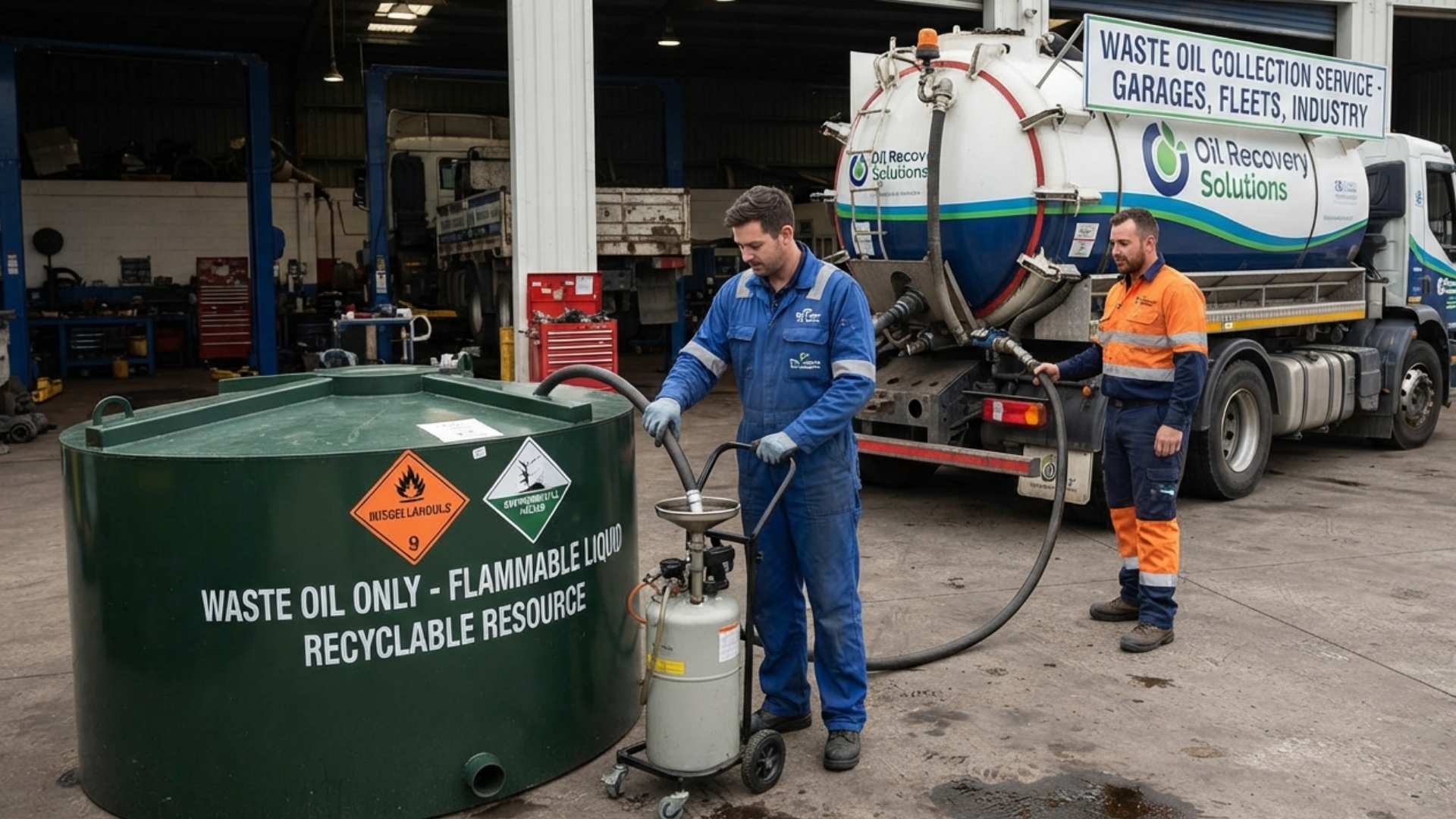
There is a drum behind every garage, a tank beside every fleet workshop, and an interceptor under every yard, all slowly filling with the same black liquid. Waste oil is the most universal industrial waste in Britain, and it lives a double life: hazardous waste on the paperwork, valuable commodity in the tanker.
Which life your oil leads is decided almost entirely by how it is stored and what it gets mixed with before collection day. Clean, segregated oil flows into one of the country’s most successful recycling chains. Contaminated oil becomes exactly what its hazard label warns: an expensive problem in a leaky drum.
Here is the working guide for garages, fleet workshops, manufacturers, and anyone else with that slowly filling container: the storage rules, the mixing sins, the collection options, and where the oil actually goes.
The Double Life: Why Clean Oil Is Worth Collecting
Used lubricating oil never stops being useful; it just stops being clean. Processed properly, it re-enters the economy as re-refined base oil, ready to become lubricant again, or as recovered fuel oil for energy-intensive industry. Either way, collected oil displaces virgin crude, which is why the recovery chain wants it and why unmixed oil moves at sensible rates, with the market even paying for good volumes at times.
Every part of that value depends on one word: unmixed. The recovery processes are built for oil, not for whatever else the workshop poured in. Which brings us to the sin list.
Never into the waste oil tank: brake cleaner, thinners, and solvents; petrol and fuel drainings; antifreeze; degreaser baths; water in quantity; and anything from the parts washer. Each one is a separate hazardous stream with its own route, and each contaminates oil beyond the recovery specification. The rule is legal as well as economic: hazardous waste streams must not be mixed, and a tanker driver who smells solvent in an oil tank is required to walk away, leaving you with a tank of blended liability that now needs specialist disposal at several times the price.
One tank, one stream. Solvents in their own drum, coolant in its own container, fuel drainings in theirs, all collected alongside the oil on the same visit but never inside it. Our solvent disposal service exists precisely for the workshop’s other liquids.
Storage: The Ten-Metre Walk That Prevents The Five-Figure Incident
Oil storage failures are rarely dramatic. They are a weeping tap over bare concrete, a bund quietly filling with rainwater until it holds nothing, a drum on its side by the back fence. Then one day the sheen reaches a drain, and a routine cost becomes a pollution incident with the Environment Agency involved, because oil in a watercourse is spectacularly visible for spectacularly long.
The defensive standard is short:
- Contain with a second skin. Tanks and IBCs sit in bunds sized to catch a full failure, as oil storage regulations require for larger containers; drums live on bunded pallets. A bund full of rainwater is disarmed, so keeping it empty is part of the routine.
- Label everything, honestly. “Waste oil” on the tank, and separate honest labels on the solvent, coolant, and fuel containers beside it. Labels are what keep the streams from merging on a busy Friday.
- Site away from drains, gullies, and the yard’s natural water path, with spill kit within reach and staff who know it exists.
- Log the drips. A monthly walk-round with eyes on valves, seams, and the ground beneath is the entire early-warning system, and it is also what inspectors and insurers ask to see.
None of this is expensive, and all of it is cheaper than one visit from a spill response contractor.
Collections That Fit The Way Workshops Actually Work
Oil accumulates at completely different rates in a two-ramp MOT garage and a distribution fleet’s workshop, so the service has to flex.
Drum and IBC exchanges suit steady small producers: the full container leaves, a clean one lands in its place, and the workshop never runs out of somewhere to pour. Tank empties serve the bigger fixed installations on schedules matched to fill rate. One-off uplifts handle the inherited mess, the acquired site, the cupboard of mystery drums, with our chemists available for anything unidentified, because as our consignment note guide explains, unknown liquids cannot lawfully travel until someone knows what they are.
Every collection runs on the same rails: UN-approved containers where we supply them, consignment paperwork prepared for you and filed for three years, confirmed dates, and mainland UK coverage up to Glasgow and Edinburgh, typically within 5 to 7 working days.
And when a site changes shape, the service goes deeper: tank cleaning, bund washing, and full tank removal for refurbishments, decommissioning, and shutdowns, interceptor and separator empties included, with every arising documented out of the gate. An oil tank is easy to install and strangely hard to get rid of; that second part is a phone call.
The Wider Fluid Family
Waste oil rarely travels alone, and a workshop clearing its oil sensibly usually finds the rest of the fluid family waiting: oily rags and absorbents (hazardous, and self-heating in piles), oil filters (crushed or whole, their own stream), fuel drainings, coolant, brake fluid, and the aerosols and part-tins our everyday hazardous waste guide catalogues. Collecting them together, each in its own right stream on one visit and one set of paperwork, is how the yard gets genuinely clean rather than selectively clean.
That consolidation is the quiet saving in professional hazardous waste management: one carrier, one date, one file, no orphan streams left breeding behind the unit.
Frequently Asked Questions About Waste Oil
How do garages dispose of waste engine oil?
Dedicated tank, drums, or IBC on site; licensed collection by exchange or tank empty; consignment note each time. Unmixed oil moves at sensible rates because recovery wants it.
Why must oil never mix with solvents or thinners?
Mixing streams is prohibited, and contamination converts recoverable oil into premium-priced disposal. Segregation is the biggest single cost lever a workshop controls.
What are the storage rules?
Bunded, labelled, leak-checked containment away from drains, with the bund kept empty of rain and a spill kit nearby. Larger containers are legally required to have secondary containment.
Where does collected oil go?
Re-refining into base oils or processing into recovered fuel: one of the UK’s most effective hazardous recycling chains, fed entirely by oil that stayed clean.
Do you handle tanks and interceptors?
Yes: empties, cleaning, bund washing, and full removal for shutdowns and site changes, all arisings documented through licensed routes.
Which areas do you cover?
Mainland UK from Bedford, as far north as Glasgow and Edinburgh, on confirmed dates, typically within 5 to 7 working days, under licence CBDU258345.
Keep The Black Stuff In Its Lane
Waste oil rewards discipline like almost nothing else in the yard: one clean stream, one bunded tank, one scheduled collection, and the hazard label spends its life pointed at a recovery plant instead of a drain.
Priority Haz collects oil from single drums to full tank farms, supplies the containers, prepares the paperwork, and handles the day the tank itself has to go. Request a quote or a callback at priorityhaz.co.uk, and give the drum behind the workshop a proper career.

