
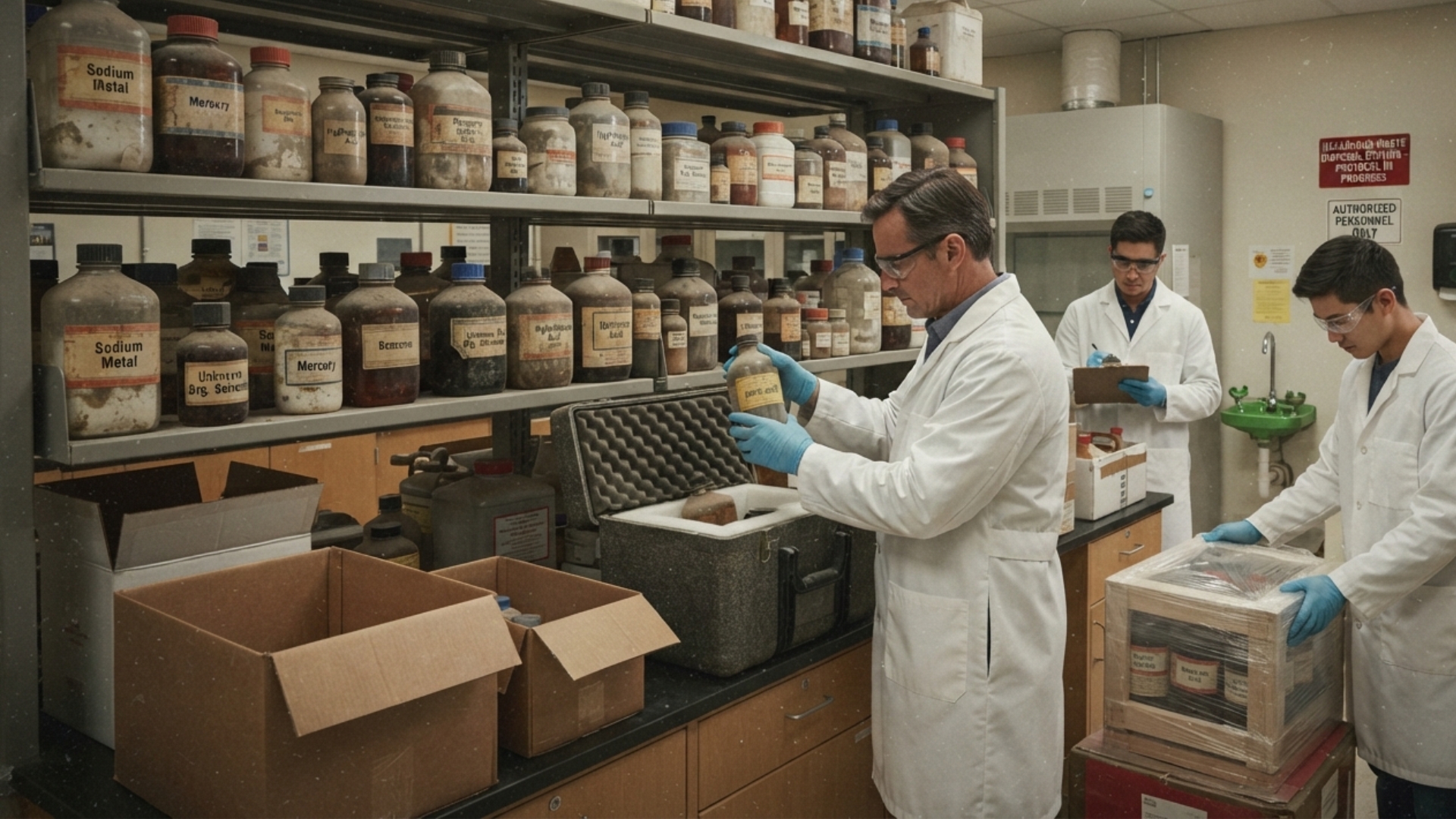
Every science department, research lab, and factory QC room has one: the back shelf. The bottles bought for a syllabus that changed, the reagents from a retired technician’s era, the jar whose label surrendered to time somewhere around 2011. Nobody uses them. Nobody throws them away. Everybody has learned not to look at them.
The back shelf survives on a perfectly human logic: it has been fine for years, and dealing with it feels complicated. But chemistry does not stand still in sealed bottles, and a shelf of ageing reagents is the one part of the building that gets quietly more dangerous while everything else just gets older.
Clearing it is a solved problem. Here is how laboratory chemical disposal actually works, for a school prep room or an industrial lab, and why the mystery bottle is the one item you should never handle yourself.
Why Old Chemicals Are A Different Kind Of Problem
Most workplace hazardous waste, the paints, oils and aerosols of our everyday items, is stable stuff handled wrongly. Laboratory chemicals invert the equation: often tiny quantities, but chemistry that changes character with age.
- Some reagents become unstable over time. The notorious example every chemistry teacher learns is picric acid, harmless enough wet, increasingly shock-sensitive as it dries. Certain ethers quietly form explosive peroxides in part-empty bottles. Alkali metals wait patiently in degraded oil. None of these is exotic; all have turned up in ordinary school prep rooms, and the correct response to finding one is to close the cupboard and call specialists, not to pick it up for a better look.
- Incompatibilities sleep on shared shelves. Oxidisers beside solvents, acids beside cyanide salts: fine until a dropped box or a leaking cap introduces them. Proper clearance is as much about what must not travel together as what anything is.
- And labels die. The unlabelled bottle is the defining object of lab clearance work, because the law is absolute: hazardous chemicals that have not been identified may not be transported. Guesswork is not permitted, and honestly, not wise. This is why our in-house chemists exist: sampling and analysis of unknowns, producing the identification reports that let everything afterwards happen lawfully, from classification to the consignment note our paperwork guide describes.
For schools, there is an extra dimension: the audience. Prep rooms sit metres from corridors of teenagers, employer duties under COSHH apply in full, and CLEAPSS guidance points schools firmly toward specialist disposal rather than improvisation. The days of the Friday-afternoon drain experiment are, thankfully, archaeology.
How A Professional Lab Clearance Actually Runs
The process is calmer than most heads of science and lab managers expect, and it is built around one principle: assessment before movement.
- The inventory conversation. You share what you know: stock lists, photographs of shelves, the location of the feared corner. Gaps and unknowns are expected; flagging them is the point, not a failure.
- Assessment and analysis. Chemists review the inventory, identify what needs sampling, and assess the high-risk categories, the potentially unstable, the incompatible, the aged, in place. Anything requiring special handling is planned for, not discovered on the day.
- Packing by compatibility. Trained staff pack chemicals into UN-approved containers, segregated by hazard class so nothing shares a box with its natural enemy, cushioned and sealed for transport. This stage, done properly, is where the risk actually leaves your building.
- Documented collection. A confirmed date, mainland UK coverage as far as Glasgow and Edinburgh, typically within 5 to 7 working days for standard work, with consignment notes prepared and your copies filed for the three-year retention.
- Onward disposal by the right route for each class: recovery where possible, high-temperature treatment where necessary, every stream to a permitted facility.
Clearances fit around real institutions: school work runs happily in holidays, industrial clearances around production windows, and ongoing arrangements, a Haz Box for the routine smalls, periodic collections for the steady streams, stop the shelf ever refilling. Our Haz Box guide covers that maintenance mode.
The Costs And The False Economy Of Waiting
Lab clearance pricing follows effort and hazard: quantity matters less than character. A hundred well-labelled bottles pack quickly; five unknowns need analysis; one suspected peroxide-former needs specialist handling. Which yields the two honest rules of lab disposal economics.
- Rule one: information is money. Every legible label, every stock record, every “we think it is roughly this” cuts assessment time. The clearance where the technician walks the shelves with us costs less than the one where we start blind.
- Rule two: age is an expense. The bottle that would have been routine in 2019 may need special measures by 2026. Chemical stores appreciate in cost the way cellars appreciate in wine, except nobody wants the vintage. An annual stock review with a small disposal collection is dramatically cheaper and safer than the decade-end crisis clearance, and it keeps the inventory list matching the shelf, which COSHH assessments assume anyway.
For industry, the same logic scales: R&D sample archives, QC retains, discontinued formulations, and site closures are lab clearances with more zeros, and tank empties and full shutdown support extend the same service to the plant floor.
Frequently Asked Questions About Laboratory Chemical Disposal
How do schools dispose of old science chemicals?
Specialist contractor, full stop: inventory, chemist analysis of unknowns, compatibility packing in UN-approved containers, consignment-documented collection. Staff never bin, pour, or drive chemicals anywhere.
What happens to unidentified chemicals?
Sampling and analysis first, always, because transporting unidentified hazardous chemicals is illegal. Identification reports then make classification, packing, and quotation possible.
Which old chemicals are most dangerous?
The changed ones: dried shock-sensitive materials, peroxide-forming ethers, and aged alkali metals. Do not touch or move suspicious veterans; specialists assess where they stand.
How often should stores be cleared?
Annual review, disposal as needed. Little and often beats the crisis clearance on cost, safety, and paperwork alike.
Can clearances run during term or production?
Yes, planned properly: holidays and weekends for schools, production windows for industry, with confirmed collection dates throughout.
Do you cover our area?
Mainland UK from our Bedford base, Glasgow and Edinburgh included, with in-house chemists, UN-approved packaging supplied, and consignment paperwork handled under licence CBDU258345.
Retire The Back Shelf
Somewhere in your building, the back shelf is waiting for someone to make it their problem. Make it ours instead: it is, quite literally, what our chemists are for.
Priority Haz clears laboratory chemicals from single prep rooms to full site shutdowns, with analysis for every mystery bottle, packing by people who know what must never share a box, and paperwork that closes the file properly. Request a quote or a callback at priorityhaz.co.uk, and open that cupboard with the company.

