
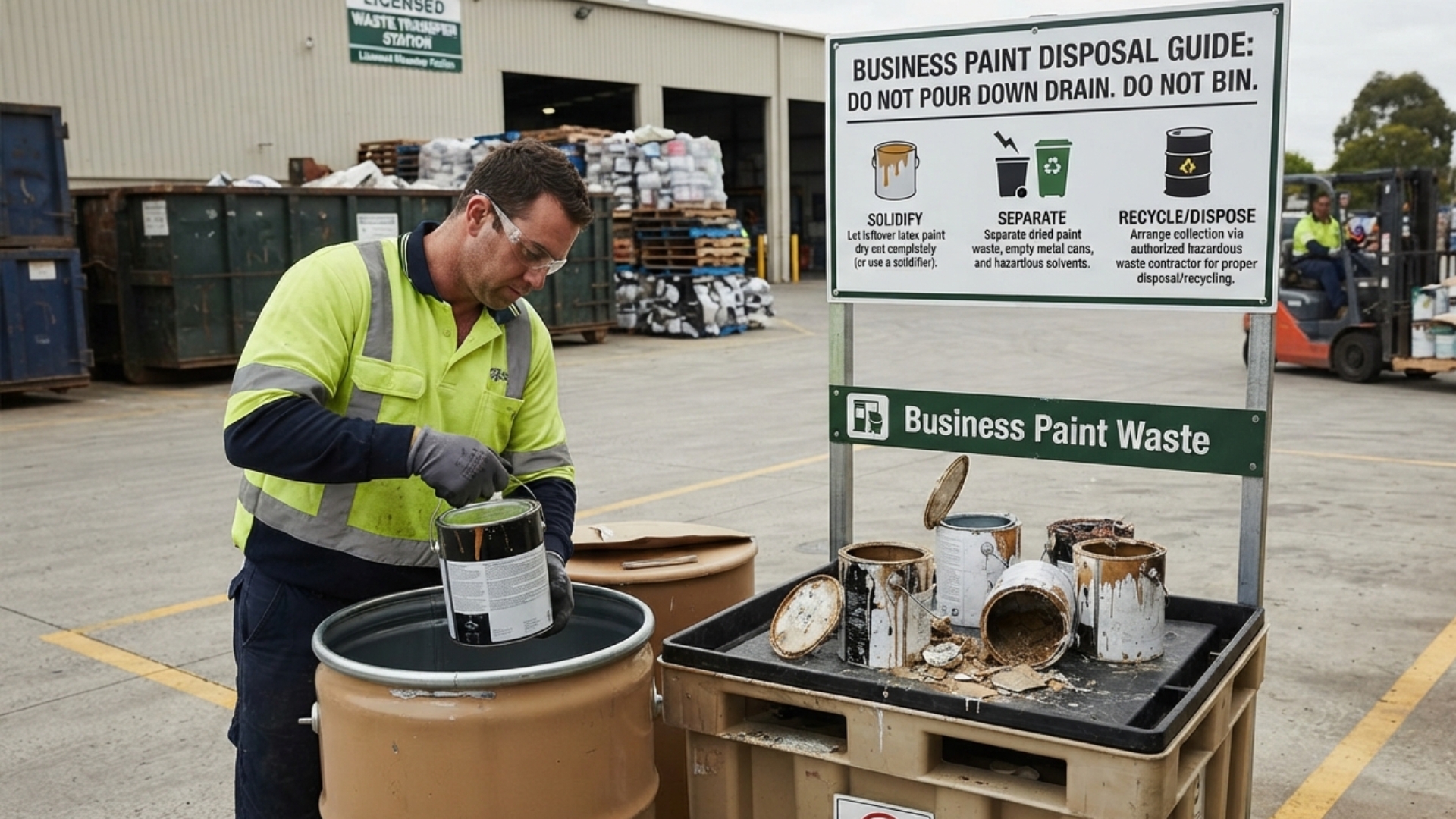
Every trade has its guilty cupboard, and for decorators, builders, facilities teams, and manufacturers, it is the paint store. Shelves of part-used tins in discontinued colours, the drums from the job that changed spec, the returns nobody logged, all quietly outlasting every office refit around them.
They persist because everyone half-knows the two easy exits are closed. Paint cannot go down the drain, where it poisons watercourses and blocks interceptors, and it cannot go in the general bin, where it is a classified hazardous waste travelling under false papers. So the cupboard grows, year by year, until an audit, a move, or a fire officer forces the question.
The good news is that the proper route is straightforward, cheaper than its reputation, and, done well, sends almost nothing to landfill. Here is how business paint disposal actually works.
Why Paint Earns Its Hazardous Status
Paint feels domestic and harmless, which is exactly why it is the most commonly mishandled hazardous stream in Britain.
- Solvent and oil-based paints are the obvious cases: flammable, ecotoxic, and carrying the hazard diamonds to prove it. Thinners, primers, specialist coatings, and two-pack systems sit in the same family, sometimes with livelier chemistry.
- Water-based paints are where businesses talk themselves into trouble. Modern emulsions still contain biocides, preservatives, and additives, and in trade quantities they are managed through the hazardous route, with the precise classification confirmed on the consignment paperwork rather than guessed at the bin. A homeowner hardening off one tray of emulsion is one thing; forty litres behind a decorating firm’s unit is a waste stream with rules.
- And the tins themselves count. As with every container in this industry, the packaging is classified by what it held. Part-used and residue-bearing tins travel with the paint; only genuinely dry, scraped-out metal escapes into ordinary recycling. Our guide to the hazardous waste hiding in ordinary businesses covers that principle across every product in the store cupboard.
Add the storage angle: quantities of flammable coatings have fire-safety implications long before disposal, and insurers and fire risk assessments increasingly ask what is in that cupboard. Clearing it is not just compliance housekeeping; it is removing an accelerant store from your premises.
Zero To Landfill: Where Good Paint Waste Actually Goes
The pleasant surprise of modern paint disposal is the destination list. Wherever possible we run paint on a zero-to-landfill basis, and the routes are genuinely productive.
- Reblending. Good-condition water-based paint can be filtered and remanufactured into recycled paint, one of the circular economy’s quieter success stories.
- Energy recovery. Solvent-based paints and unusable mixtures have real calorific value, and processed correctly they displace fossil fuel as secondary fuel in energy-intensive industry.
- Solvent recovery. Thinners and wash solvents can be distilled and returned to use, which is why keeping them segregated from general paint waste pays.
- Treatment as the backstop, for the residues and oddities that fit nowhere better.
None of this happens to paint that leaves through the wrong door. Down the drain it is pollution; in the general bin it is contamination; with a cash-in-hand van it is next month’s fly-tip with your name recoverable from the tins, a scenario our consignment note guide explains in uncomfortable detail. The productive destinations are reached only through described, documented, licensed collection.
What A Trade Paint Collection Looks Like
The process is simpler than most first-time customers expect.
- Tell us what you have. Tin count or pallet estimate, types where known (solvent versus water-based matters), and photographs of the store. Perfect inventory is not required; honest description is. Unlabelled or mystery containers get flagged for our chemists, because unidentified chemicals cannot lawfully travel.
- Get the packaging right, or borrow ours. Small volumes suit a Haz Box or lidded drum; bigger clearances run to pallets, drums, and IBCs, all UN-approved, which we can supply ahead of collection along with storage advice for the waiting period.
- Collection on a confirmed date. Mainland UK, Glasgow and Edinburgh included, typically within 5 to 7 working days, with the consignment note prepared for you and the classification agreed before the vehicle arrives.
- Paperwork back, cupboard empty. Your consignment copy goes in the three-year file, and where the paint was stock rather than waste, recalled product, obsolete branded lines, evidence of destruction is available as standard.
Costs scale with volume, type, and packaging rather than distance-from-normal: a few tins ride economically in a Haz Box, while manufacturers’ drum and IBC volumes are quoted by weight and stream. The one lever every customer controls is description: accurately described paint prices at its true rate, while mystery mixtures price at the cautious one. The tidy cupboard is literally cheaper.
For The Producers And Retailers: Beyond The Odd Tin
Decorating firms and facilities teams clear cupboards; manufacturers, distributors, and retailers face paint waste at a different scale, and the same infrastructure serves them.
Off-spec batches, line changeovers, returned and damaged stock, discontinued ranges, and recalled product all need documented destruction as much as disposal, particularly where brand protection matters. Tank washings and wash solvents join the solvent recovery routes, and full tank and bund empties, cleaning, and removal are their own service for site changes and shutdowns. The thread through all of it is the same: classification, compliant packaging, consignment paperwork, and destinations chosen for recovery before disposal.
Whatever the scale, the wrong answer is the same one: waiting another year while the shelf fills.
Frequently Asked Questions About Business Paint Disposal
How should a business dispose of old paint?
Licensed hazardous collection with consignment paperwork, never drains or general waste. Good providers run zero-to-landfill routes into reblending, energy recovery, and solvent recovery.
Is water-based paint hazardous waste?
Trade quantities are managed through the hazardous route, with classification confirmed on the paperwork. Solvent and oil-based paints are unambiguous from the start.
Can empty paint tins go in general waste?
Residue-bearing tins travel with the paint; only genuinely dry, scraped metal belongs in ordinary recycling. Trade part-used tins are part of the collection.
What happens to collected paint?
Reblending into recycled paint, secondary fuel in energy recovery, solvent distillation, or treatment, in roughly that order of preference. Landfill is the route we work to avoid.
How much does it cost?
A few tins in a Haz Box: little. Pallets, drums, and IBCs: quoted by weight and type. Honest description is the cheapest thing in the whole process.
Do you collect paint nationwide?
Yes: mainland UK up to Glasgow and Edinburgh from our Bedford base, on confirmed dates, typically within 5 to 7 working days, containers supplied where needed.
Open The Cupboard This Month
Every guilty paint cupboard is one collection away from being an ordinary cupboard again, with a consignment note in the file where the liability used to sit on the shelf.
Priority Haz (licence CBDU258345) collects paint from single-trader clearouts to manufacturers’ pallet loads, zero to landfill wherever possible, with packaging supplied, paperwork handled, and in-house chemists for the tins that lost their labels. Request a quote or a callback at priorityhaz.co.uk, and give the discontinued colours somewhere useful to go.

