
Waste solvent is the only hazardous stream most businesses hold that is genuinely worth something.
Used thinners, dirty cleaning solvent, contaminated white spirit and spent degreaser can often be distilled back into usable product. The material has value. That is the upside.
The downside is that the same drum, stored badly, is one of the most dangerous things on a commercial site. Solvent vapour is heavier than air; it collects at floor level, and it will find an ignition source across the room.
Both facts are true at once, and how you handle the drum decides which one you get.
What counts as waste solvent
Broader than most people think. If a liquid was used to dissolve, thin, clean or degrease, its waste is a solvent waste.
- Paint thinners, white spirit, turpentine substitute
- Spent brush cleaner and gun wash from spray operations
- Degreasers from workshops and engineering
- Acetone, IPA, MEK and other cleaning solvents from laboratories and manufacturing
- Print industry wash-up solvent and blanket wash
- Contaminated fuel used as a cleaning agent, which happens more often than it should
- Solvent-contaminated rags, wipes and filters, which are a separate solid stream
Most waste solvents sit under absolute hazardous entries, meaning they are hazardous by definition and no assessment is required to decide it. Typically they carry several HP properties at once: flammable, irritant and ecotoxic.
Where the storage goes wrong
The single biggest issue is vapour, and vapour is invisible.
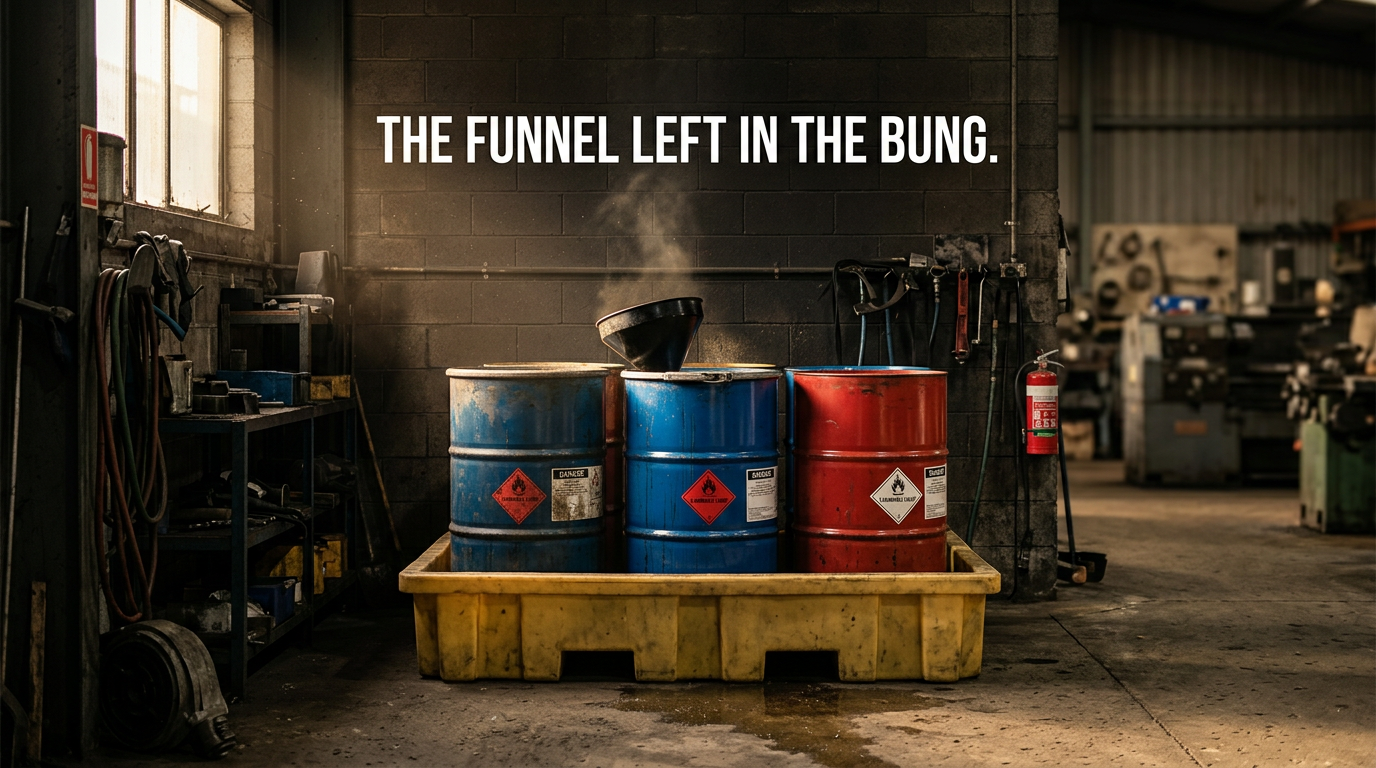
Keep containers closed. Not “mostly closed”, not a lid resting on top. An open drum is continuously releasing flammable vapour into the room. A funnel left in the bung is the most common version of this.
Bund everything. Secondary containment sized to hold at least 110% of the largest container, or 25% of the total volume stored, whichever is greater. Bunding is not just a spill measure; it stops a leak reaching a drain.
Keep it away from ignition sources. Vapour is heavier than air and travels along the floor. That means sockets at low level, forklift traffic, grinding, welding and heaters all matter, and they can be a surprising distance away.
Ventilate. A sealed store with no air movement lets vapour concentration build. Natural high and low level ventilation is the usual answer.
Segregate. Solvents away from oxidising agents, acids and alkalis. Never store solvent waste next to bleach or peroxide.
Bond and earth when decanting. Pouring solvent generates static, and static is an ignition source. Bonding the containers together removes that.
DSEAR, briefly and usefully
The Dangerous Substances and Explosive Atmospheres Regulations apply to any workplace holding flammable liquids, and a solvent store qualifies.
In practice that means you need:
- A risk assessment covering the flammable substances present
- Hazardous area zoning, identifying where an explosive atmosphere could form
- Equipment suitable for the zone, meaning appropriate electrical fittings inside it
- Controls to eliminate or reduce the risk, and measures to mitigate the effects
- Information and training for anyone working there
Most small solvent stores need a fairly simple assessment. The mistake is not having one at all, and DSEAR is one of the things an inspector asks about early because it is quick to check.
Recovery, and why it changes the price conversation
Here is the part worth pushing your supplier on.
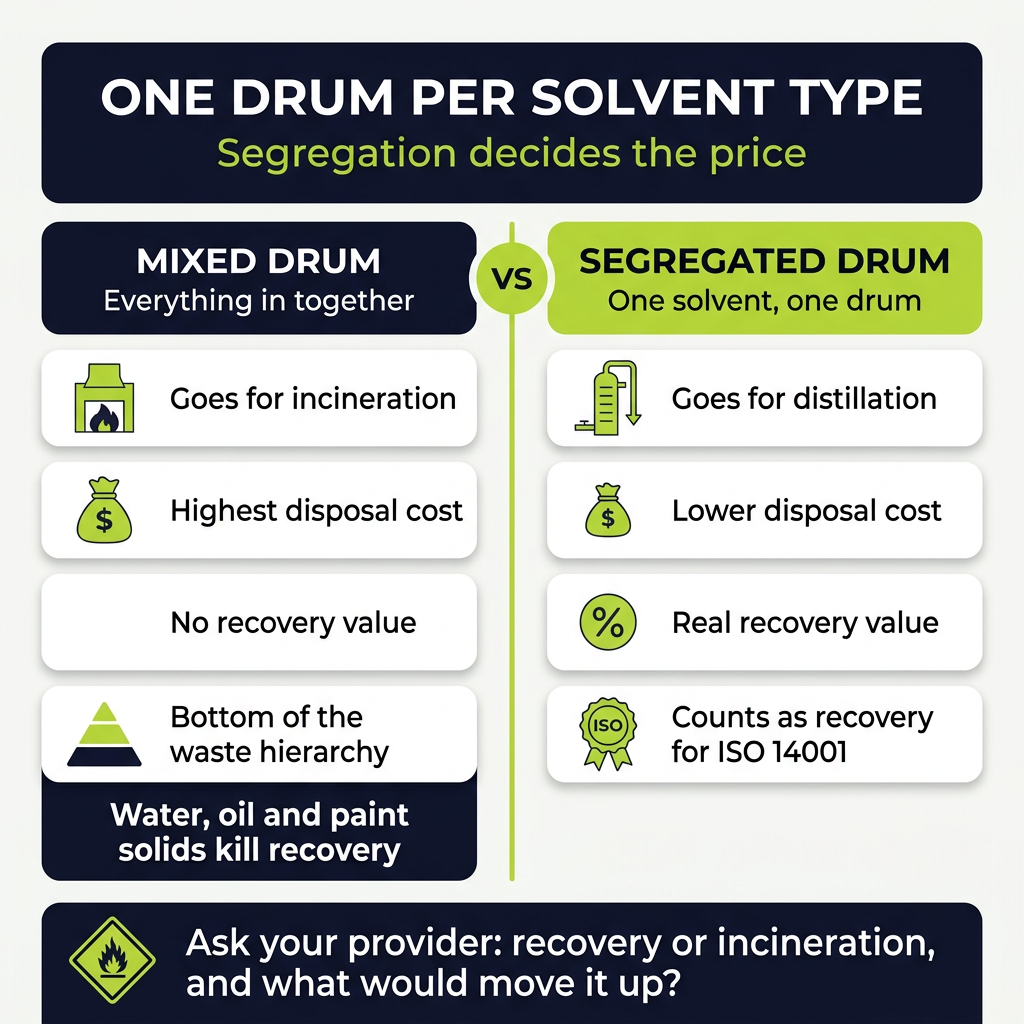
Waste solvent can often be recovered by distillation. The used solvent is heated, the clean solvent evaporates and is condensed back into usable product, and the contamination is left behind as a much smaller volume of residue.
That matters commercially in two ways. Recovery is higher up the waste hierarchy than incineration, which helps if you report on sustainability or hold ISO 14001. And a solvent with recovery value costs less to dispose of than one destined purely for incineration.
Whether your waste can be recovered depends almost entirely on how well it is segregated.
- A drum of a single, identifiable solvent has real recovery value
- A drum of mixed solvents has some
- A drum of mixed solvents contaminated with water, paint solids, oil and whatever else went in it has none, and goes for high-temperature incineration at the highest cost
One drum per solvent type, wherever your process allows. That single habit is the difference between a stream that partly pays for itself and one that is purely a cost.
Ask your provider directly: is this going for recovery or incineration, and what would we need to change to move it up?
The solid stream people forget
Solvent-contaminated rags, wipes, filters, absorbent granules and empty containers are hazardous waste too, and they behave differently from the liquid.
Oily and solvent-soaked rags in a pile can self-heat. Left in a bin liner in a warm corner over a weekend, they are a genuine spontaneous combustion risk. It is one of the more common causes of workshop fires.
Store them in a lidded metal container, kept separate, and collected on a schedule rather than when somebody notices.
Empty solvent containers are usually still hazardous. A drum that held solvent retains residue and vapour, and it needs to leave site through the hazardous route unless it has been properly cleaned.
Frequently asked questions
Is waste solvent hazardous waste?
Almost always, yes. Most waste solvents fall under absolute hazardous entries on the List of Waste, meaning they are hazardous by definition with no assessment needed. They typically display several hazard properties at once, commonly flammable, irritant and ecotoxic, and must move under a hazardous waste consignment note.
Can waste solvent be recycled?
Often, yes. Solvent can be recovered by distillation and returned to usable product, which sits higher up the waste hierarchy than incineration and usually costs less to process. Recovery depends on segregation: a drum of a single identifiable solvent has real value, while a drum of mixed and contaminated solvent generally has none.
How should waste solvent be stored?
In closed containers inside secondary containment sized to at least 110% of the largest container, away from ignition sources and drains, with adequate ventilation, and segregated from oxidisers, acids and alkalis. A solvent store falls under DSEAR, so you also need a risk assessment and hazardous area zoning.
Are solvent-soaked rags hazardous waste?
Yes, and they carry a fire risk that the liquid does not. Solvent- and oil-soaked rags can self-heat and ignite spontaneously when piled together, particularly in a warm space over a weekend. Store them in a lidded metal container, separate from other waste, and have them collected on a schedule.
Do empty solvent drums need special disposal?
Usually yes. A container that held a hazardous substance is generally still classified as hazardous because of the residue and vapour it retains. It should leave site through the hazardous route unless it has been properly cleaned to a documented standard.
The bottom line
Waste solvent rewards being organised and punishes being casual, and the same three habits cover both.
Keep the containers closed and bunded, keep the types separated, and keep the rags in a metal bin with a lid. Do that, and the fire risk drops and the disposal cost drops with it.
Priority HAZ collects waste solvent from businesses across mainland UK, including small volumes, with recovery routed wherever the material allows it and full consignment documentation. Request a quote, and we will look at what your segregation could be worth.

