
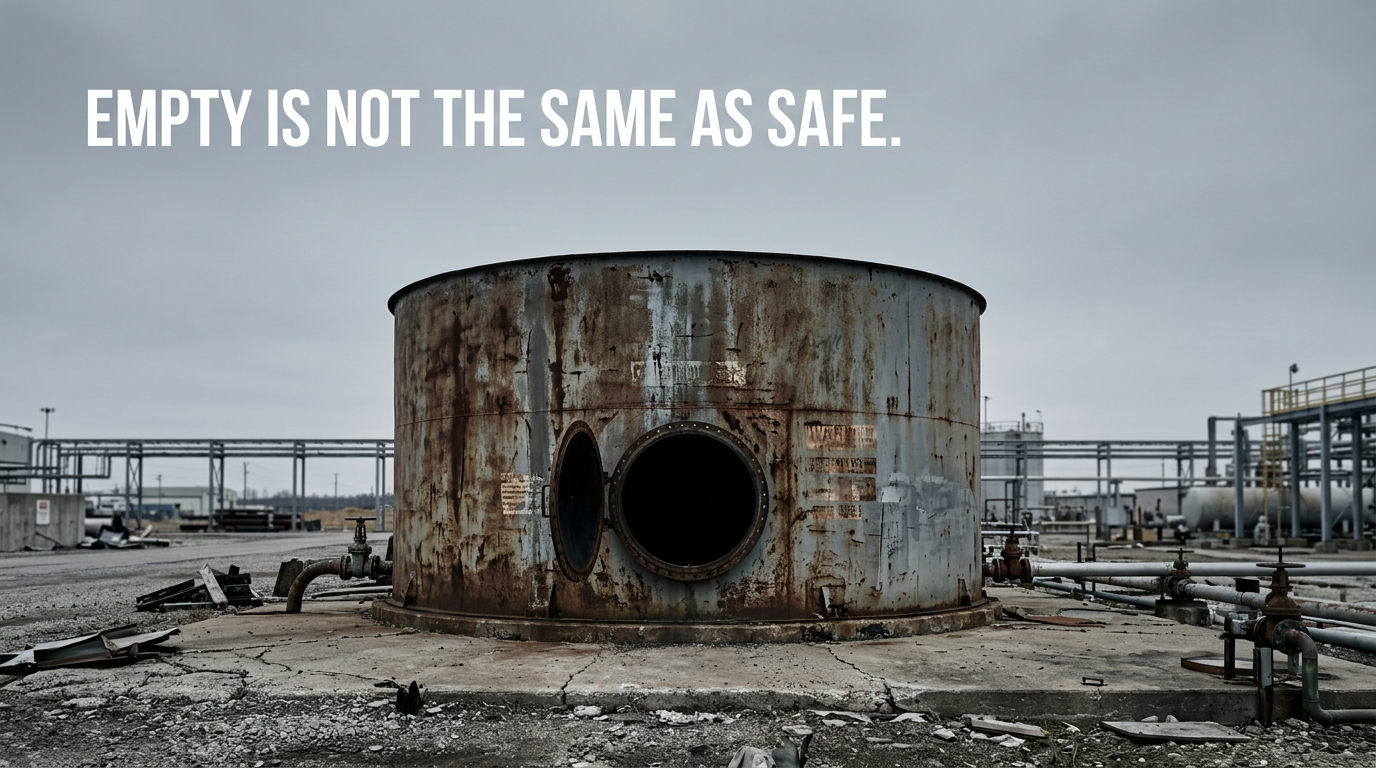
Pumping the liquid out of a tank takes an afternoon.
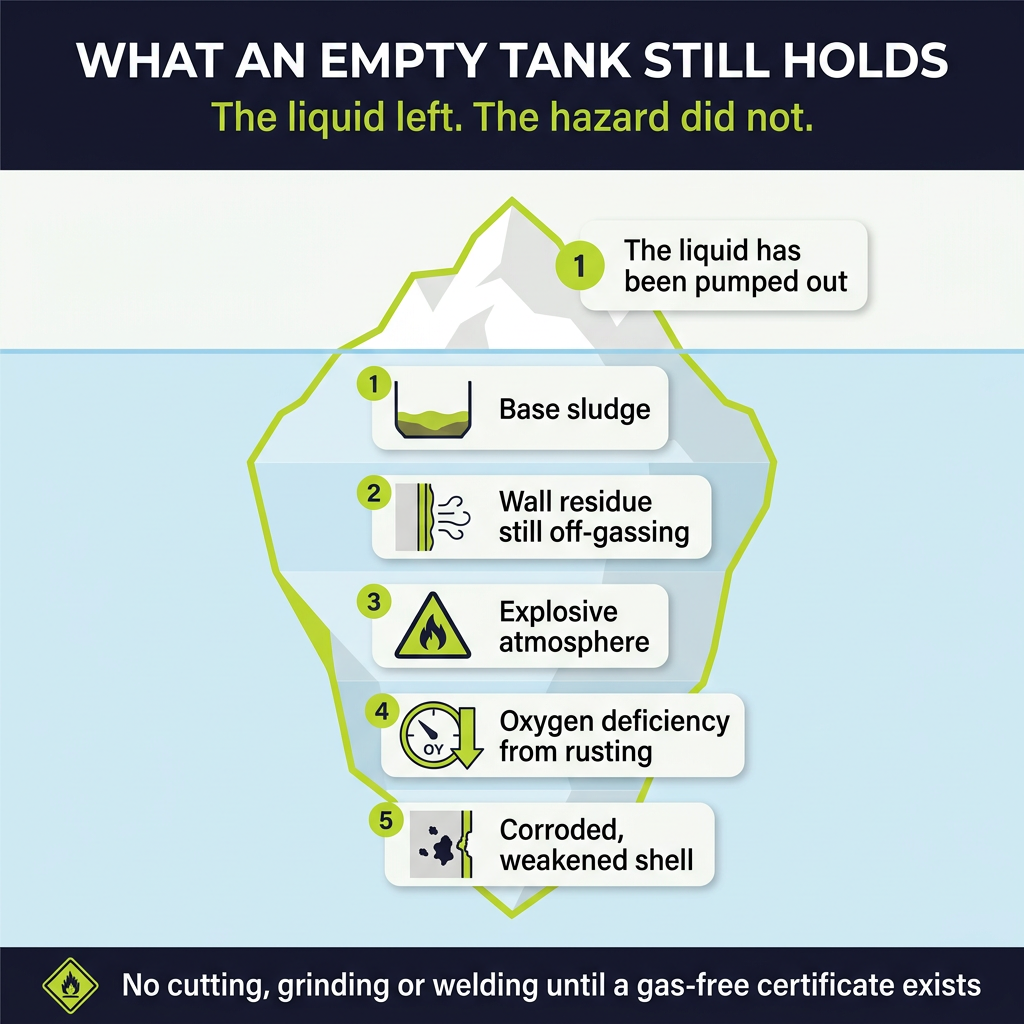
What remains is sludge in the base, residue on the walls, and an atmosphere inside that may be flammable, toxic, oxygen-deficient or all three. That atmosphere does not leave with the liquid. In some cases it gets worse, because the liquid was suppressing vapour release and now nothing is.
More people are killed in the UK by confined space atmospheres than by the substances they were storing. A tank that has been “emptied” is one of the most dangerous structures on any industrial site, and it stays that way until it has been cleaned, tested and certified.
What is actually left in an empty tank
Sludge. Heavy fractions, water, rust, scale and solids settle in the base over years. In a fuel or oil tank, this can be a substantial depth, and it is usually a more concentrated hazardous waste than the product ever was.
Wall residue. Films and deposits that continue to release vapour.
Vapour. A tank that held solvent or fuel holds an explosive atmosphere long after the liquid has gone. It only takes a spark from an angle grinder outside the shell.
Oxygen deficiency. Rusting consumes oxygen. So does purging with nitrogen. A tank can be perfectly clean of product and still asphyxiate someone within a breath or two.
Water. Rainwater ingress and condensation, contaminated by whatever it has been sitting in.
Structural weakness. Corroded steel that has been held together by the product inside it.
Confined spaces, which is where the deaths happen
A tank is a confined space, and the Confined Spaces Regulations 1997 apply. The core principle is straightforward: avoid entry if the work can be done another way.
A great deal of tank cleaning can now be done without anyone going in, using high-pressure jetting through existing openings, vacuum extraction and remote inspection. If entry can be avoided, it must be.
Where entry is genuinely unavoidable, it requires a safe system of work with, at minimum:
- A specific risk assessment and a written permit to work
- Atmospheric testing before entry and continuous monitoring throughout, covering oxygen, flammables and toxics
- Isolation of all connected pipework, physically, not just valved off
- Forced ventilation
- Trained personnel with appropriate breathing apparatus
- A top man stationed outside with communications maintained
- Rescue arrangements ready before entry, with the equipment on site and the team briefed
That last point is the one that turns incidents into multiple fatalities. The overwhelming majority of confined space deaths include would-be rescuers who went in after a colleague without equipment. Rescue has to be planned before anyone enters, not improvised afterwards.
The order the work has to run in
- Establish what was in it. Product records, delivery notes, and where there is genuine doubt, sampling and analysis of the residue. The residue often classifies differently from the original product, so do not assume.
- Isolate and de-energise. All connected pipework physically disconnected or blanked, pumps isolated and locked off, electrical supplies dead.
- Remove the liquid and sludge. Vacuum tanker for the bulk, then the base sludge, which is the slow part and the part that gets underestimated.
- Clean. Jetting and vacuum extraction, usually without entry.
- Purge and test. Make the atmosphere safe, then verify it with instruments rather than assumptions.
- Gas-free certificate. A written certificate from a competent person confirming the tank is safe. Nothing hot happens before this exists. No cutting, no grinding, no welding.
- Decommission or remove. Either remove the tank entirely, or leave it in place, cleaned and permanently isolated, sometimes foam-filled.
- Check what is underneath. Buried and bunded tanks that have leaked leave contaminated ground. Removing the tank without checking the soil leaves the liability in place for whoever owns the site next.
- Paperwork. Consignment notes for every waste stream, the gas-free certificate, and a decommissioning record.
The waste streams a tank produces
Usually three or four, and they classify separately.
- Residual product, which may have recovery value if it is fuel or oil
- Base sludge, almost always hazardous and usually the most expensive stream
- Contaminated wash water and interceptor arisings
- The tank shell itself, which is scrap metal with real value once gas-free, and a hazardous item before that
- Contaminated soil, if there has been a leak
The shell is worth mentioning to your contractor explicitly. A cleaned steel tank has scrap value that can offset a meaningful part of the removal cost, but only if it is handled as metal recovery rather than mixed disposal.
Interceptors and separators, the tank people forget
Every site with a fuelling point, a wash bay or a workshop yard has an interceptor, and it is a tank.
They need scheduled emptying and cleaning, and the arisings are hazardous. An interceptor that has not been serviced does not fail quietly. It passes oil straight through to the surface water drain, which becomes a pollution incident traced directly back to you.
If you cannot remember when yours was last emptied, that is the answer to when it needs doing.
Frequently asked questions
Is an empty tank safe to work on?
No. An emptied tank retains sludge, wall residue and an atmosphere that can be flammable, toxic or oxygen-deficient. Rusting alone consumes enough oxygen to asphyxiate someone. No hot work, cutting or grinding should take place until the tank has been cleaned, tested and issued with a gas-free certificate by a competent person.
Do I need confined space entry to clean a tank?
Often not. Much tank cleaning is now done without entry, using high-pressure jetting through existing openings, vacuum extraction and remote inspection. The Confined Spaces Regulations 1997 require entry to be avoided where the work can reasonably be done another way, so entry should be the last option rather than the default.
What is a gas-free certificate?
A written certificate from a competent person confirming that a tank’s atmosphere has been tested and is safe, with no flammable, toxic or oxygen-deficiency hazard. It is the document that permits hot work such as cutting or welding. No hot work should ever be carried out on a tank without one.
What happens to the tank itself after removal?
Once cleaned and certified gas-free, a steel tank is scrap metal with genuine value that can offset part of the removal cost. Before certification, it is a hazardous item and must be handled as one. Agree with your contractor in advance whether the shell is going for metal recovery.
How often should an interceptor be emptied?
It depends on the site and the loading, but it should be on a scheduled service rather than done reactively. An unserviced interceptor stops retaining oil and passes it straight into the surface water drain, which becomes a pollution incident attributed to the site operator. Arisings are hazardous waste.
The bottom line
The dangerous phase of a tank’s life begins when it stops being used.
Find out what was in it, get the residue out, clean it without entry if at all possible, and do not let anyone near it with a grinder until a gas-free certificate exists. Then check what is under it before you sign the site off.
Priority HAZ empties, cleans and removes redundant tanks and interceptors across mainland UK, including sampling of unknown residues, gas-free certification and metal recovery on the shell. Request a quote, and we will survey the tank before we price it.

