
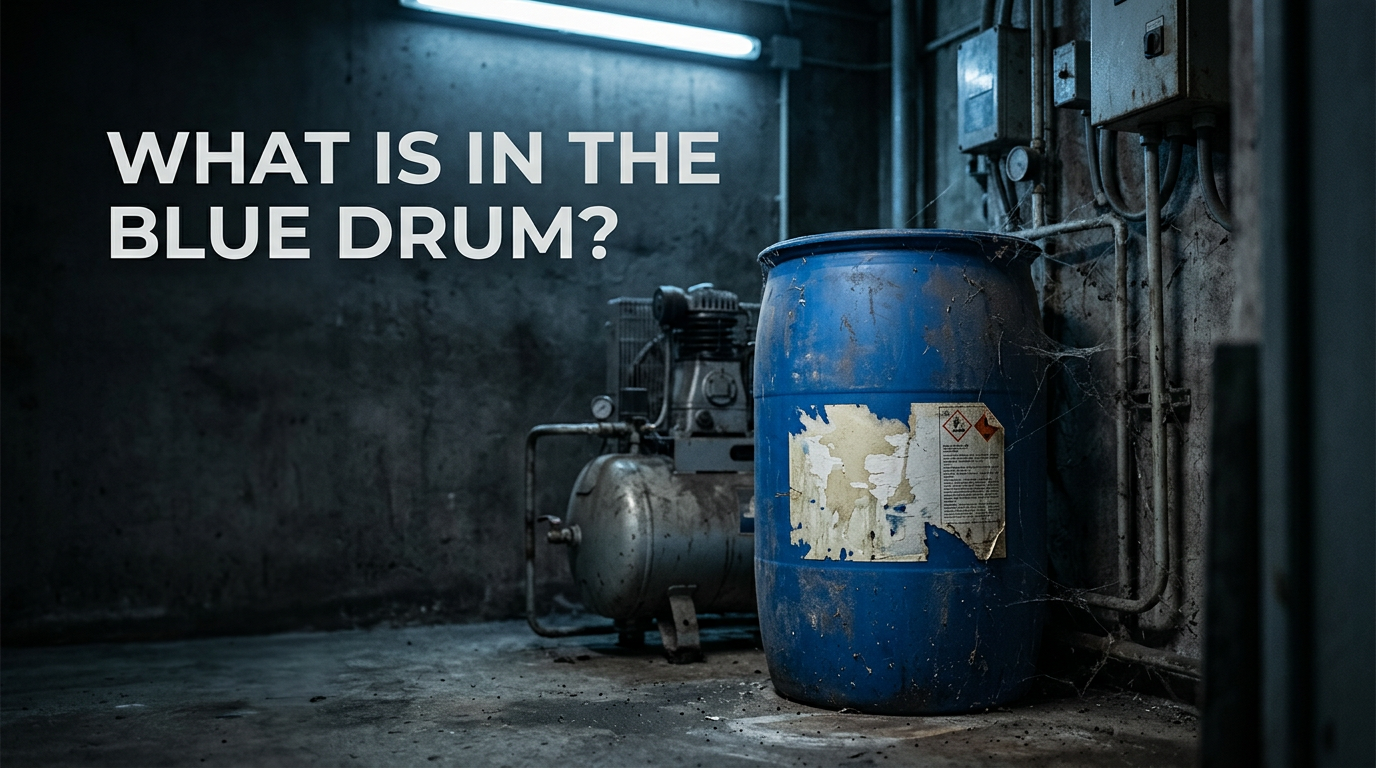
It is behind the compressor; it has been there longer than anyone currently employed, and the label came off years ago.
Somebody thinks it might be coolant. Somebody else says it smells like solvent. The maintenance manager remembers a contractor leaving it during a refit around 2018.
That drum cannot be collected, cannot be classified, and cannot be moved off site until somebody establishes what is in it. Guessing is not an option, and here is why, plus what actually happens instead.
Why a guess is worse than no answer
Declaring a waste incorrectly on a consignment note is a serious matter. It counts as a misdeclaration rather than a paperwork slip, and the consequences land in several places at once.
The load gets rejected. Treatment facilities test incoming material. A drum declared as one thing and found to be another is refused, and it comes back to you at your cost.
The transport is wrong. Hazard class determines how something travels, what it travels in and what documentation goes with it. A misdeclared load can be an unlawful movement.
People get hurt. The real risk. A driver, a loader or a plant operator handles the material on the basis of what you told them. If a drum declared as waste oil is actually acid, somebody finds out the hard way.
It reacts. Unknown liquids bulked into a tanker with incompatible material is how you get a reaction inside a vehicle.
So the honest position, when the label is gone, is that you do not know. And the fix is straightforward.
What sampling and analysis actually involves
It is less involved and less expensive than most people expect.
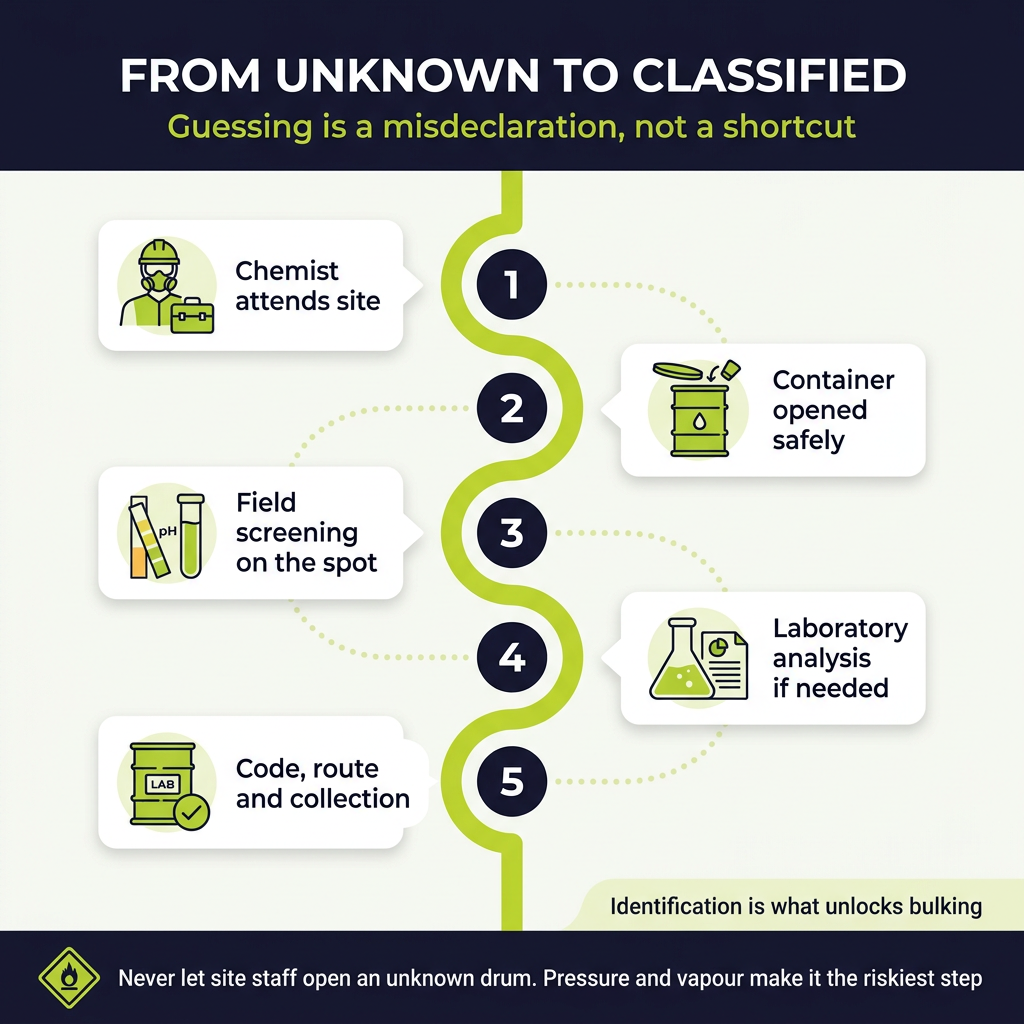
A chemist attends site. Someone competent, equipped and insured, who is used to opening containers whose contents are not known. This matters, because opening an unknown drum is the highest-risk moment in the whole process. Pressure can have built up. The contents may be reactive. It is not a job for the site maintenance team.
The container is opened safely, and a sample is taken. A small volume, into an appropriate sample container, labelled and logged against the drum.
Field screening happens on the spot. Simple checks narrow things down quickly: pH, whether it is water or solvent-based, flash point indication, reaction to a spot test, and physical properties such as layering, viscosity and odour. For many drums, this is enough to classify.
Laboratory analysis where field screening cannot settle it. Full characterisation gives you a defensible result.
You get a classification. The correct List of Waste code, the hazard properties, the right disposal route, and a written result you can put on file behind the consignment note.
The waste is packed and collected, often on the same visit if the chemist is attending anyway.
The bulking-up conversation
The other thing a site chemist does is work out what can safely travel together.
A store with forty part-used containers is not forty separate collections. Once contents are known, compatible materials can be bulked into larger containers or lab-packed, which cuts the cost substantially.
But that only happens after identification. Bulking unknowns is how reactions start, and no competent contractor will do it.
This is the practical reason sampling usually pays for itself on a store of any size. Identification is what unlocks consolidation.
Where unknowns come from
Recognising the pattern helps you stop generating them.
- Contractor leftovers after a refit, an installation or a maintenance visit
- Inherited stock when a business takes on a building or acquires a site
- Decanted product in unlabelled secondary containers, which is a COSHH breach as well as a disposal problem
- Degraded labels, particularly on containers stored outdoors or in damp stores
- Laboratory and school prep rooms, where reagents accumulate over decades
- Retired equipment still holding fluids, such as transformers, compressors and hydraulic systems
- Mixed drums where somebody topped one container up with another
Two habits prevent almost all of it: never decant into an unlabelled container, and make removal of leftover chemicals a written condition of every contractor’s job.
What to do before anyone arrives
Do not open it. No matter how curious anyone is.
Do not move it further than you must, and if you do, keep it upright and supported.
Isolate it. Away from drains, away from heat, away from anything it could react with, and away from anything valuable. If it can go into secondary containment, do that.
Photograph it. The container, any remaining label fragments, the cap, and any staining or corrosion. Photographs are genuinely useful to the chemist before they arrive.
Write down what anyone remembers. Which contractor, roughly when, what work was being done, what the site used at the time. Partial memory narrows the field considerably.
Check for a delivery note or invoice from around that period. It is surprising how often the answer is in the purchase records.
Treat it as hazardous for storage and handling until you know otherwise.
Frequently asked questions
How do I dispose of an unlabelled drum of chemicals?
You cannot classify it from a desk, so it needs sampling and analysis by a competent chemist who attends site, opens the container safely, takes a sample and characterises it. That produces the correct waste code and disposal route. Until then, isolate it away from drains and heat and treat it as hazardous.
Can I just declare an unknown chemical as general hazardous waste?
No. Consignment notes require a specific code and an accurate description. A misdeclaration risks the load being rejected at the treatment facility, makes the transport arrangements potentially unlawful, and puts drivers and operators at risk because they handle the material based on what you declared.
How much does chemical sampling and analysis cost?
Less than most people expect, and materially less than a rejected load or a misdeclared consignment. Many drums are settled by on-site field screening without needing full laboratory work. On a store with several containers, the sampling usually pays for itself, because identification lets compatible materials be bulked together instead of collected separately.
Is it safe to open an old drum to see what is inside?
No, and it should not be attempted by site staff. Pressure can build inside sealed containers, contents may have degraded into something more reactive, and opening releases vapour of unknown composition. This is the highest-risk step in the process and needs someone equipped, trained and insured for it.
How do I stop unknown chemicals accumulating?
Never allow decanting into unlabelled containers, and write removal of surplus chemicals into every contractor’s scope so nothing is left behind. Keep an inventory of any chemical store, review it annually, and replace labels as soon as they start to degrade.
The bottom line
An unidentified container is not a disposal problem yet. It is an identification problem, and it stays frozen until somebody solves it.
Isolate it, photograph it, ask around, and get a chemist to it. Everything after that is routine.
Priority HAZ provides chemist site attendance, sampling and analysis across mainland UK, identifying unknowns and packing them for collection on the same visit wherever possible. Request a quote and tell us how many unknowns you have.

