
Hazardous waste regulation was written with tankers and drum stores in mind, but most of the businesses it covers look nothing like that. They look like a hair salon with a shelf of finished aerosols. A print shop with spent toner and blanket wash tins. A school site office with a box of dead batteries and half the maintenance cupboard. A village garage, a care home, a farm workshop.
These are the small producers, and for years they have faced a genuinely unfair puzzle: their volumes are too small to justify industrial waste logistics, but the law never gets proportionally smaller. One aerosol is as illegal in the general bin as one thousand.
The Haz Box service exists to close exactly that gap, and it is the most common first step businesses take with us. Here is how it works, who it suits, and the handful of rules that keep it simple.
The Idea: Compliance As A Container
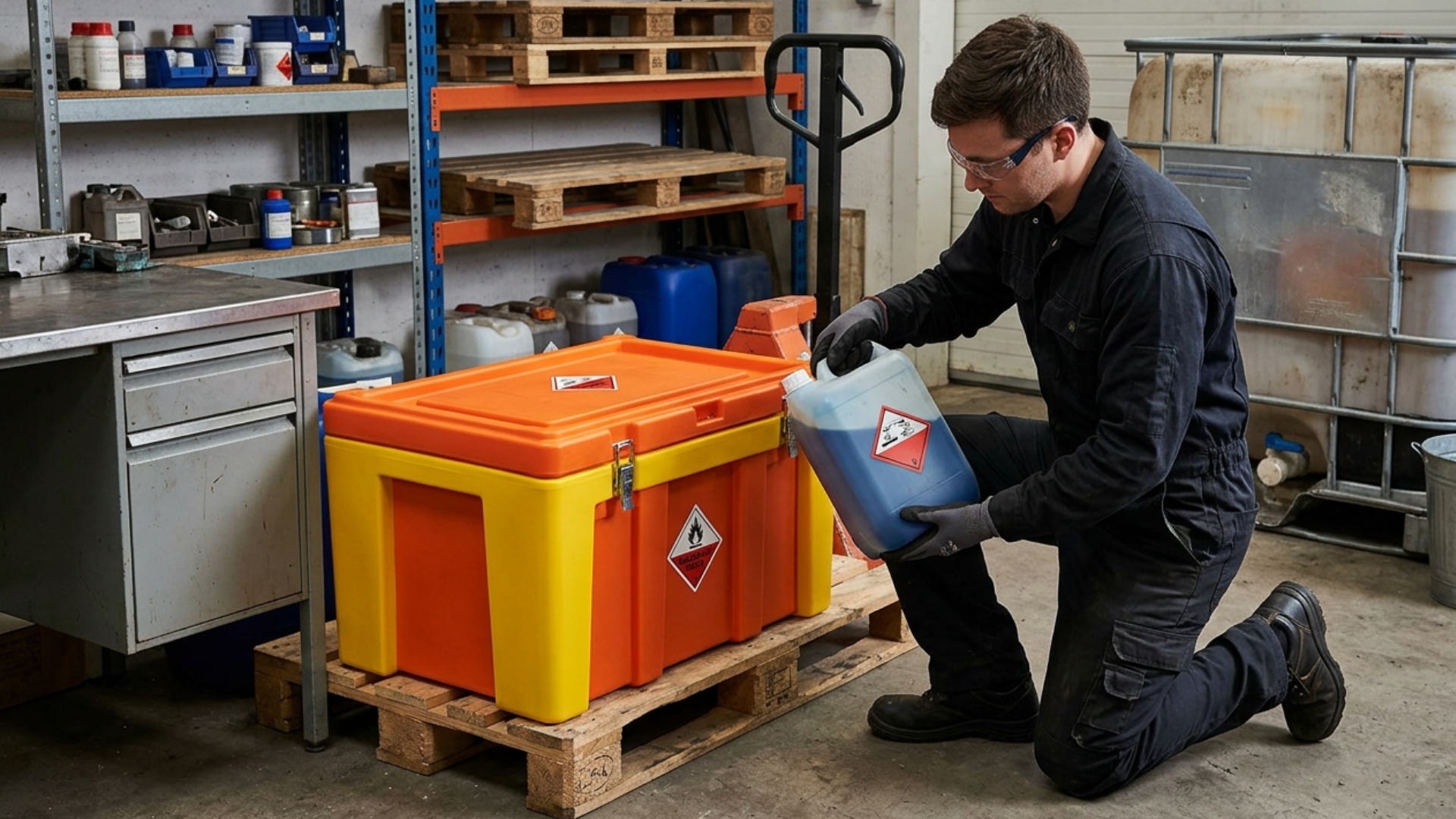
A Haz Box is a UN-approved container, typically around 60 litres, that lives at your premises as the permanent, legitimate home for small hazardous items.
The everyday routine could not be plainer: when a hazardous item is finished with, the aerosol, the toner, the adhesive tube, the part-tin, it goes in the box instead of the bin. No decisions, no research, no guilt pile behind the fire exit. The box is the decision, made once.
When it fills, you call. The full box is collected, and a fresh one takes its place, and the movement travels on a consignment note prepared for you, joining the three-year file that our paperwork guide explains. Storage, transport packaging, and documentation, solved by one object and one phone call, with collections on confirmed dates across mainland UK, Glasgow and Edinburgh included, typically inside 5 to 7 working days.
For steadier producers, the same service runs on a schedule instead of on request, and multi-site businesses run a box per site with consolidated arrangements. The shape flexes; the compliance does not.
What Goes In, What Stays Out
A Haz Box handles the classic small-producer stream, the same cast our everyday hazardous waste guide identifies in every workplace: aerosols, batteries, toner and ink, adhesives and sealants, small paint tins, small cleaning chemicals and other labelled containers, packed sensibly within compatibility guidance we supply with the box.
Three families stay out, each for good reason.
The unknowns. The unlabelled bottle does not go in the box, because unidentified chemicals cannot lawfully travel; they wait for our chemists to sample and analyse, as they do in every lab clearance.
The specialists. Asbestos has its own sealed, marked containment and dedicated collections. Clinical and sharps waste run their own routes. Fluorescent tubes travel better in tube-specific containers, which we also supply, unbroken tubes being worth protecting.
The volumes. When a stream outgrows the box- twenty litres of the same solvent, a shelf of paint, drums of oil, it graduates to its own service at better rates: paint collections, waste oil exchanges, solvent disposal. The box is for variety in small amounts, not quantity in disguise.
If sorting that boundary sounds like work, it is precisely the conversation a quote request starts: describe what your business produces, and the right mix of box, containers, and collections comes back priced.
Who The Box Quietly Rescues
The Haz Box customer list is a portrait of ordinary Britain, and a reminder of how far the hazardous waste net reaches.
Salons and barbers with aerosols by the hundred per year. Printers and sign-makers with inks, wash solvents, and adhesives. Schools whose site teams accumulate everything from paint to batteries, quite apart from the science prep room’s separate needs. Offices and care homes with toner, tubes, batteries, and cleaning chemicals. Farms, whose workshop smalls sit alongside the agrochemical store we service separately. Maintenance and FM teams, the champions of the part-used tin. Village garages and MOT stations, whose oils go one route and whose aerosols, filters, and odds-and-ends fill a box alongside.
What unites them is not chemistry; it is arithmetic. Their hazardous waste arrives item by item, and the Haz Box is the only service shaped like that arrival.
The Compliance Story A Small Business Gets To Tell
Here is what changes on paper the week a Haz Box lands, and why inspectors, auditors, landlords, and insurers respond to it.
Before: hazardous items in the general waste (an offence, and increasingly a detected one), or an informal hoard awaiting a plan (an unmanaged store, unlabelled and probably incompatible). Either way, no documentation, no answer to the simple audit question “where does your hazardous waste go?”
After: segregated storage in a UN-approved container, authorised collections under licence CBDU258345, and consignment notes on file for every movement. The audit question takes one sentence and one folder to answer, and environmental policy claims, the ones customers and tenders ask about, stand on evidence rather than intention.
For the cost involved, modest and quoted plainly, it is the highest ratio of compliance-per-pound available to a small business, which is why it is so often the first service ordered and the last cancelled.
Frequently Asked Questions About The Haz Box Service
What is a Haz Box?
A UN-approved container, around 60 litres, living at your premises as the compliant home for small hazardous items, swapped and documented at each collection.
Who needs one?
Any business whose hazardous waste arrives by the item: salons, printers, schools, offices, farms, workshops, maintenance teams. Small volumes, full-size legal duties, box-shaped answer.
What goes in it?
Aerosols, batteries, toner, adhesives, small tins and labelled chemicals, within the compatibility guidance supplied. Unknowns await analysis; asbestos, sharps, and bulk streams have dedicated routes.
How often is it collected?
On request as it fills, or scheduled for steady producers, with a replacement box each time and paperwork for the three-year file.
Does it make us compliant?
For small mixed hazardous waste, substantially yes: storage, collection, and documentation in one arrangement. Specialist and bulk streams keep their own services.
Where is the service available?
Mainland UK from our Bedford base, up to Glasgow and Edinburgh, on confirmed dates, typically within 5 to 7 working days.
Give The Small Stuff A Proper Home
Somewhere in your premises, the finished aerosols and dead batteries are waiting for a policy. The policy is a box.
Priority Haz supplies Haz Boxes with the guidance, collections, and consignment paperwork built in, alongside every specialist route the box cannot cover. Request a quote or a callback at priorityhaz.co.uk, and make hazardous waste the most organised small thing in the building.

