
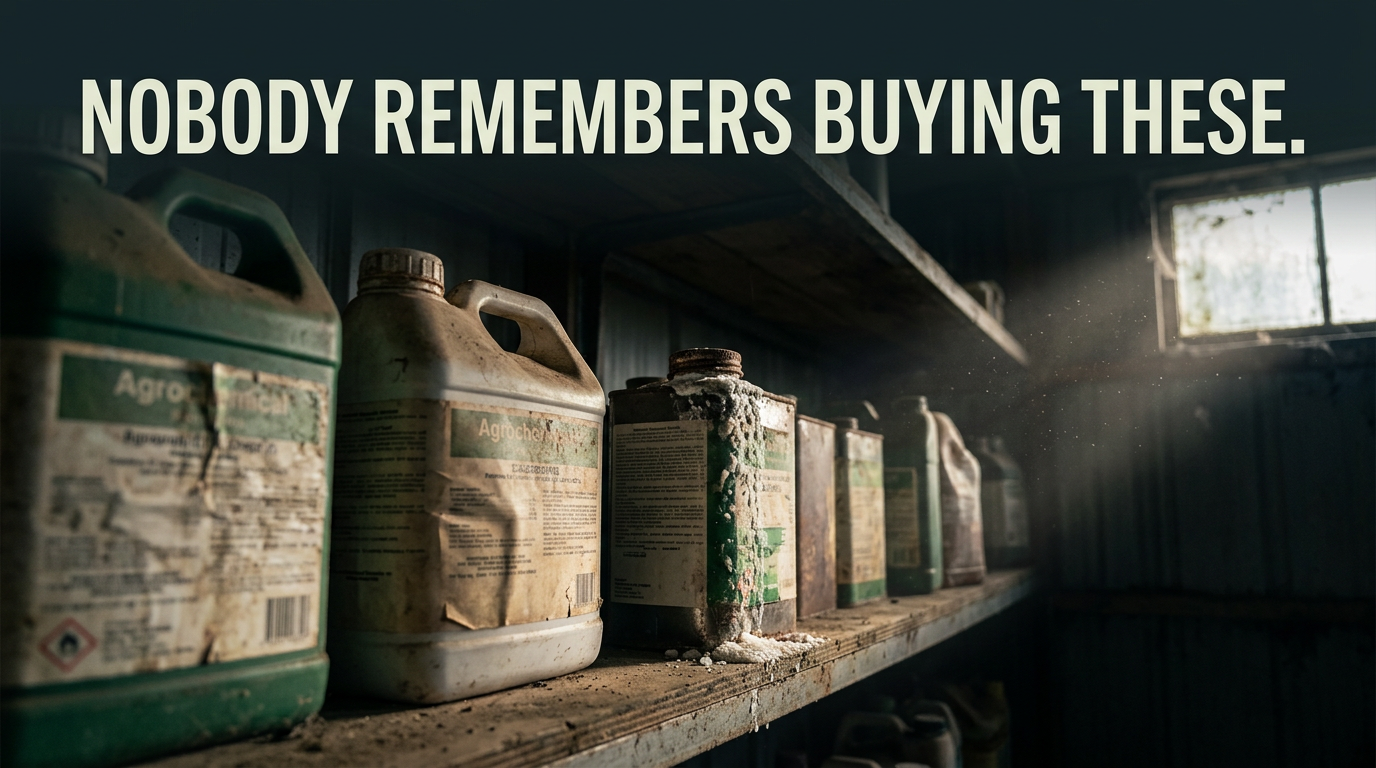
Every farm chemical store has one. The bottom shelf, at the back, where the containers have faded labels and nobody currently on the payroll remembers buying them.
Some of them will be products whose approval was revoked years ago. Some will have lost their labels entirely. A few will be swollen, crystallised or leaking.
Nothing on that shelf can be used, and none of it can go anywhere except through a licensed hazardous waste route. Here is how to deal with it properly.
Why obsolete stock cannot just be used up
When a plant protection product loses its approval, there is normally a final use-up date published alongside the withdrawal. After that date, using the product is an offence, regardless of how much you paid for it or how much is left in the container.
This catches people out because the instinct is entirely reasonable: it is a working product, it cost money, and spraying it off feels like the tidy solution.
It is not. Applying a revoked product risks prosecution, and it puts your assurance scheme membership at risk. Red Tractor, LEAF and similar schemes all check chemical stores, and obsolete stock sitting on a shelf is a standard finding.
The other trap is the reverse: leaving it there indefinitely because disposal costs money. An unusable product deteriorating in a store is a growing liability, not a saving.
What counts as agrochemical waste
Broader than pesticides alone:
- Plant protection products whose approval has been revoked or which are past their use-up date
- Part-used containers where the product is still approved but the container has been open for years
- Unidentifiable products with degraded or missing labels
- Damaged containers, including swollen, corroded or leaking ones
- Crystallised or separated products that can no longer be applied safely
- Sheep dip and veterinary chemicals
- Biocides, rodenticides and wood preservatives
- Contaminated absorbent from spills in the store
- Empty containers that have not been triple-rinsed
- Fuel, oil and adjuvants stored alongside, which are separate streams but usually need clearing at the same time
Most agrochemicals are hazardous, frequently ecotoxic and often acutely toxic, so they move under consignment note with a licensed carrier.
Empty containers, triple rinsing and the small print
Properly triple-rinsed containers can usually go through a non-hazardous route, and rinsate goes into the spray tank for application. That is standard practice, and it saves money.
The conditions matter. The container must be rinsed three times, or pressure-rinsed with dedicated equipment, immediately after emptying rather than months later once the residue has dried on. It must then be drained, capped off or left open according to your provider’s requirement, and stored dry and secure.
A container that has sat with residue drying inside it for two seasons will not rinse clean, and it stays hazardous.
Doing a chemical store clear-out safely
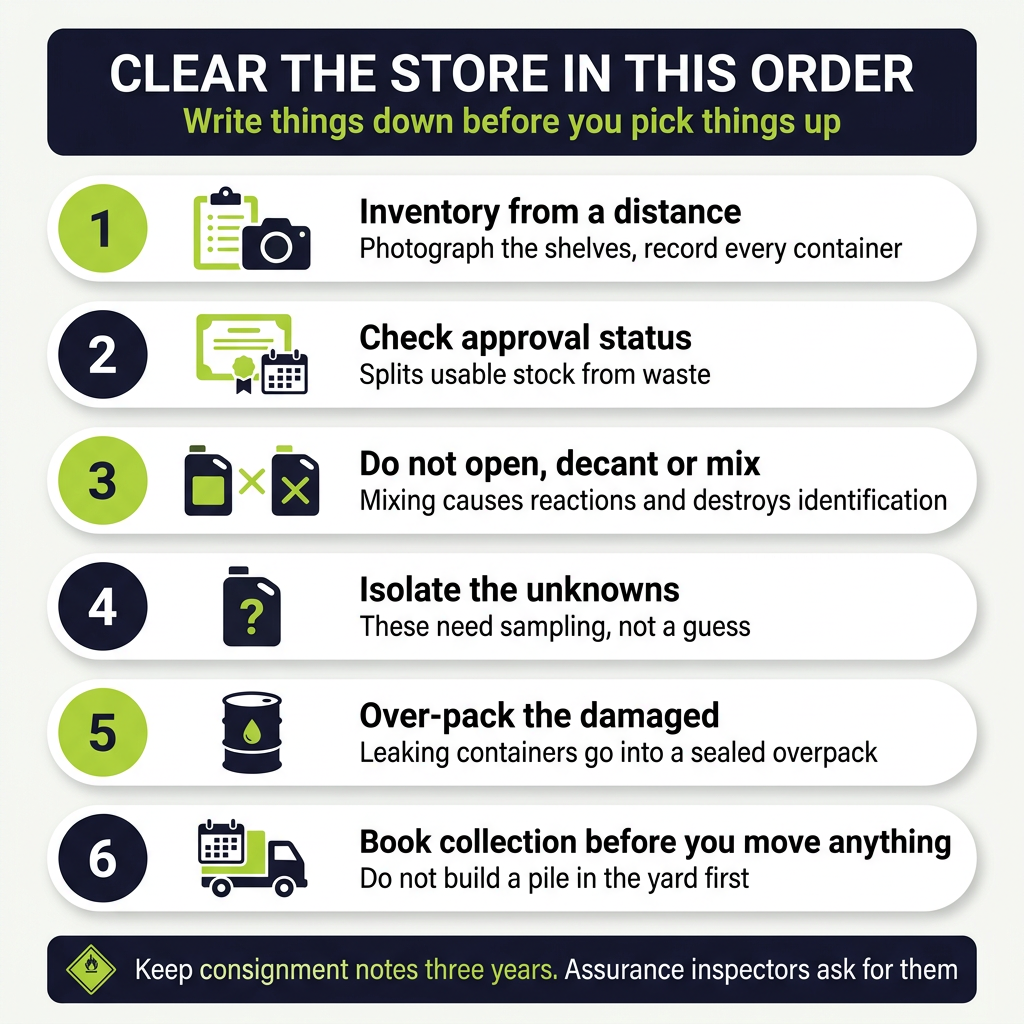
Do not start by picking things up. Start by writing things down.
- Inventory from a distance first. Walk the store with a clipboard and record every product, its size, an estimate of how full it is, and the condition of the container. Photograph the shelves.
- Check approval status against the current register for anything you intend to keep. This splits the store into usable stock and waste before anything is moved.
- Do not open, decant, bulk up or mix anything. Combining two part-used containers to save space can cause a reaction, and it destroys the identification that makes disposal straightforward.
- Isolate the unknowns. Anything without a legible label goes into its own group. It will need sampling and analysis rather than a guess.
- Deal with damaged containers separately. Leaking or swollen containers should be over-packed into a larger sealed container by someone competent, not carried across a yard in a bucket.
- Get the collection booked before you move anything. Agrochemical collections need planning and the right vehicle. Do not create a pile in the yard and then start ringing round.
- Keep the paperwork. Keep consignment notes for at least three years, and hold the inventory with them. Assurance scheme inspectors ask.
Storage for the stock you are keeping
The clear-out is a good moment to fix the store itself.
- Bunded, sealed floor with no drain connection, sized to contain a spill
- Locked and signed, with restricted access
- Frost-free but not overheated, because freezing and heat both degrade formulations
- Segregated so herbicides, insecticides and fungicides are separated, and nothing sits next to fuel or oxidisers
- Fitted with a spill kit appropriate to the volumes held, kept outside the store rather than inside it
- Inventoried, with a written stock list kept current and a copy held off-site for the fire service
That last point is easy to skip and genuinely important. If a chemical store catches fire, the first thing the fire service needs is a list of what is in it.
Frequently asked questions
Can I use up pesticides after their approval is revoked?
No. Revoked products carry a final use-up date, and applying them after that date is an offence regardless of how much stock remains. It also puts assurance scheme membership at risk. Obsolete stock must be disposed of through a licensed hazardous waste route.
How do I dispose of unidentifiable chemicals in a farm store?
Isolate them from the rest of the store, do not open or mix them, and have them sampled and analysed by a competent chemist. Analysis gives a defensible classification and the correct waste code. Until identified, treat and store them as hazardous.
Do empty pesticide containers count as hazardous waste?
Not if they have been properly triple-rinsed or pressure-rinsed immediately after emptying, drained and stored correctly, in which case they can usually take a non-hazardous route with the rinsate going into the spray tank. Containers left with residue drying inside them remain hazardous.
What paperwork do I need for agrochemical disposal?
A hazardous waste consignment note for each collection, kept for at least three years, along with confirmation the carrier holds upper tier registration. Keep your store inventory with the notes, since assurance scheme inspections routinely ask to see both.
How should a farm chemical store be laid out?
Bunded with a sealed floor and no drain connection, locked and signed with restricted access, frost-free but not overheated, with product types segregated and kept away from fuel and oxidisers. Keep a spill kit outside the store and a current stock list, with a copy held off-site for the fire service.
The bottom line
The shelf at the back is not going to improve on its own. Obsolete agrochemicals degrade, containers fail, and the clean-up gets harder and more expensive every season it is left.
Inventory it from a distance, split usable stock from waste, isolate the unknowns, and book the collection before anything moves.
Priority HAZ collects obsolete agrochemicals, unidentified products and damaged containers from farms, estates and groundcare businesses across mainland UK, with sampling and analysis where labels are gone. Request a quote, and we will scope the store before we quote it.

