
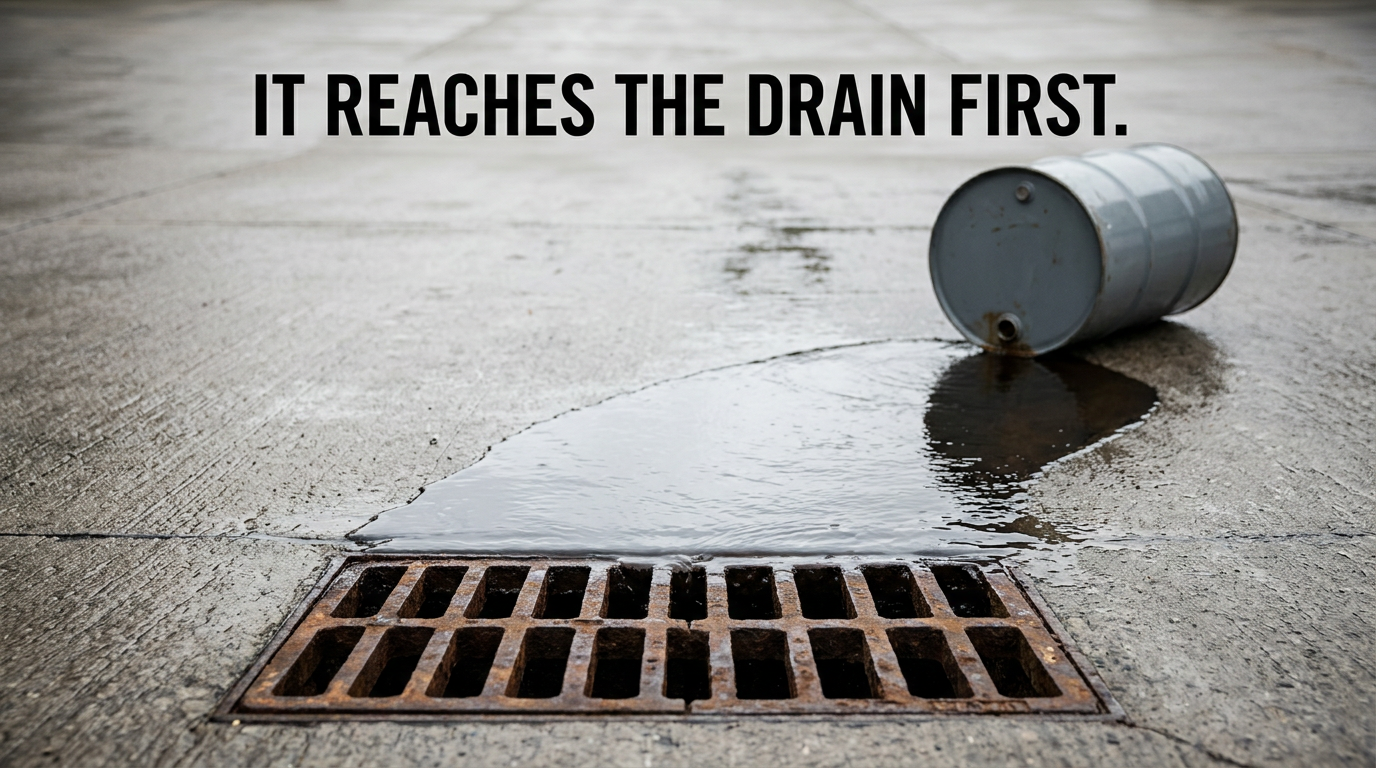
A forklift catches the corner of a drum in the yard. Two hundred litres start moving across concrete that slopes gently towards a gully nobody has ever paid attention to.
You have somewhere between a few seconds and a few minutes before it reaches that gully. What happens in that window decides whether this is an inconvenience or a prosecution.
Almost every business has a spill kit. Far fewer have decided, in advance, who does what.
Know where your drains go before anything happens
This is the single most useful thing on this page, and most sites cannot answer it.
Foul drains go to a treatment works. Contamination there is bad and expensive, but it is treatable, and it is a contained problem.
Surface water drains go, usually, straight to a watercourse. No treatment. Whatever enters is in a stream within minutes.
Yard gullies are very often surface water. So are car park drains and roof downpipes. People assume anything with a grating leads somewhere sensible, and frequently it does not.
Do this today. Get a drainage plan, walk the site, and physically mark every drain: blue for surface water, red for foul. Paint or a colour-coded disc. It takes an afternoon, and it means that in an emergency nobody is making an assumption.
The first five minutes
Order matters, and the order is not what instinct suggests.
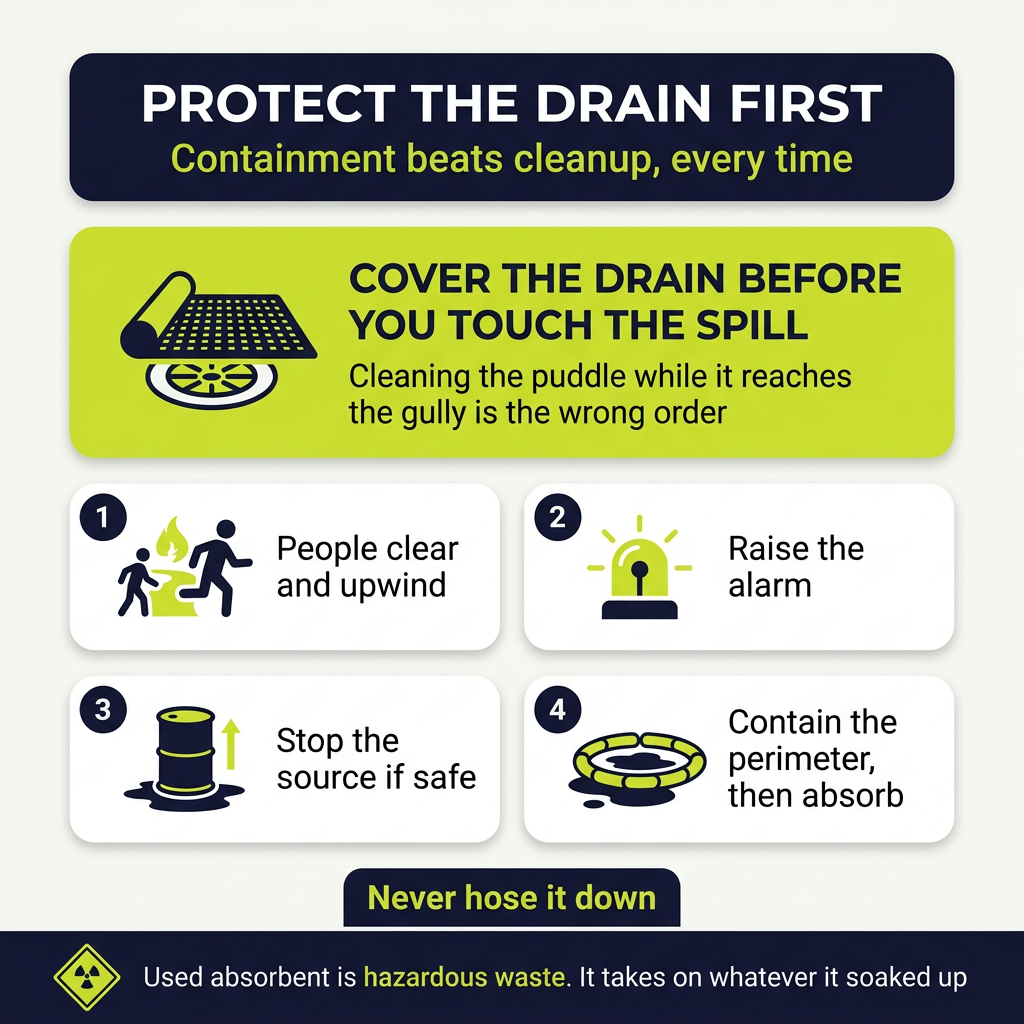
- People first. Get anyone not needed out of the area, upwind. If there is vapour, or the substance is unknown, evacuate wider rather than narrower.
- Raise the alarm. One person makes the calls while others act. Do not have everyone doing the same thing.
- Stop the source, if it is safe. Upright the container, close the valve, plug the split only if you can do it safely and in appropriate PPE. A drum that is still going is a bigger problem than the puddle.
- Protect the drain before you clean the spill. This is the step people get backwards. Cleaning up a puddle while the leading edge reaches a gully is the wrong priority. Drain mats, drain plugs or an absorbent boom across the approach come first. Containment beats cleanup every time.
- Contain the perimeter. Booms or granules around the outside edge, working inward. Never start in the middle.
- Then absorb and recover. Once it is contained and cannot spread.
Do not wash it away
The instinct in a yard is to reach for a hose. It feels like cleaning up.
It converts a contained spill into a much larger volume of contaminated water, moving faster, and it is the single most reliable way of putting a substance into a watercourse. Water spreads the problem; it does not solve it.
The only exception is where an emergency service instructs it as part of a controlled response.
Choosing a spill kit that matches what you hold
Generic kits are common and often wrong for the site.
Maintenance or general-purpose absorbents take most liquids, including chemicals, and are the sensible default for a mixed store.
Oil-only absorbents are hydrophobic. They float and take oil off water, which is right for a fuelling point or an interceptor but useless for an acid spill.
Chemical or hazmat absorbents handle aggressive substances such as acids and caustics without reacting.
Two rules beyond the type:
Size it to your largest single container, not to a tidy notional volume. If you store 205-litre drums, a 20-litre kit is decoration.
Put it outside the store, not inside it. A spill kit locked inside the room that is now on fire or full of vapour is unreachable. Site it on the approach.
Add drain protection to every kit. Mats and plugs are inexpensive, and they are the piece that actually prevents the offence.
The used absorbent is hazardous waste
This gets missed constantly, and it is a straightforward breach.
Absorbent that has soaked up a hazardous substance becomes that hazardous waste. Granules that absorbed solvent are solvent waste. Pads that soaked up acid are acid waste. They carry the same classification and need the same route: a licensed carrier, a consignment note and three-year record retention.
Bagging used absorbent into general waste is one of the most common hazardous waste offences on UK sites, and it is entirely avoidable.
Practical arrangement: keep a lidded, labelled container beside the spill kit specifically for used absorbent, so there is somewhere obvious for it to go. Otherwise it ends up in a bin bag by the back door.
Contaminated PPE, gloves and oversuits go the same way.
When you have to report it
If a spill reaches, or may reach, a watercourse, groundwater or a surface water drain, report it. In England, that is the Environment Agency incident hotline, 0800 80 70 60, which runs 24 hours. Scotland, Wales and Northern Ireland have equivalents.
Report early. Self-reporting a contained incident is viewed very differently from an incident discovered later by an inspector or reported by a member of the public who saw discolouration in a stream.
Also notify your water company if it entered the foul sewer, and your insurer.
Then write it up: what was spilled, how much, when, where it went, what you did, and what you are changing. That record is the difference between an incident and a pattern.
Frequently asked questions
What should you do first in a chemical spill?
Get people clear and upwind, raise the alarm, then stop the source if it is safe to do so. Protect the drains before you start cleaning the spill itself, because containment matters more than cleanup. Only once the spill cannot spread should you begin absorbing and recovering it.
Is used spill absorbent hazardous waste?
Yes. Absorbent that has soaked up a hazardous substance takes on that substance’s classification, so granules that absorbed solvent are solvent waste. It needs a licensed carrier, a hazardous waste consignment note and three-year record retention. Contaminated PPE goes the same route.
Should I hose down a chemical spill?
No. Washing a spill down converts a contained problem into a much larger volume of contaminated water moving faster, and it is the most likely way of getting a substance into a watercourse. Use absorbents and containment instead, unless an emergency service specifically instructs otherwise.
Who do I report a chemical spill to in the UK?
If a spill reaches or may reach a watercourse, groundwater or a surface water drain, call the Environment Agency incident hotline on 0800 80 70 60, which operates 24 hours, or the equivalent body in Scotland, Wales or Northern Ireland. Notify your water company if it entered the foul sewer, and your insurer.
What size spill kit does my business need?
Size it to your largest single container rather than a notional volume, so a site storing 205-litre drums needs a kit that can deal with 205 litres. Match the absorbent type to what you hold, and site the kit outside the store on the approach, so it is still reachable if the store is unsafe.
The bottom line
Spill response is decided long before the spill. Whether your drains are marked, whether the kit fits the drum, whether it is stored where you can reach it, and whether anyone knows to go for the gully before the puddle.
Mark the drains this week. It is the cheapest thing on this list and the one that does the most.
Priority HAZ collects contaminated absorbent, spill arisings and damaged containers across mainland UK under full consignment documentation, and can advise on containment before you need it. Request a quote, and we will look at your storage and drainage risk.

