
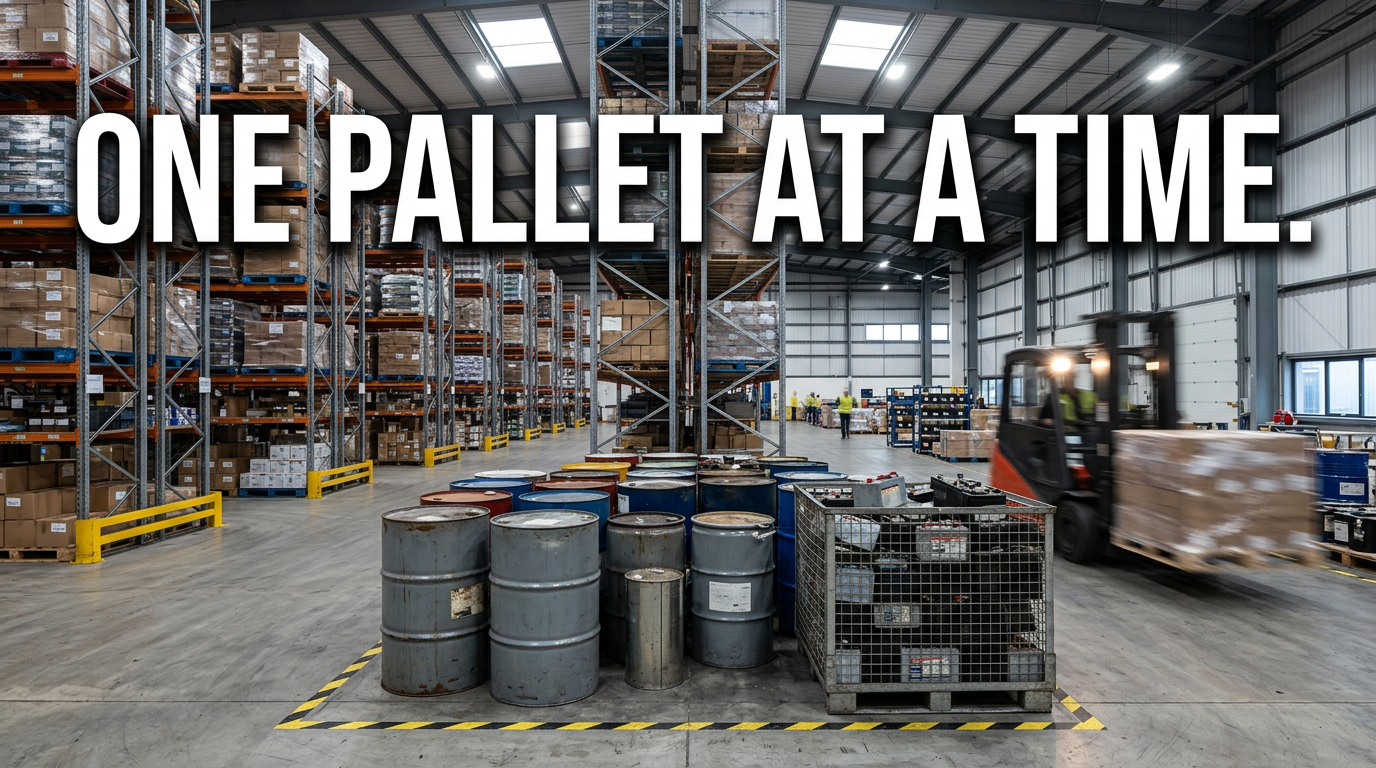
A distribution shed does not look like a chemical site. There is no tank farm, no reactor, nobody in a chemical suit.
Then you walk to the back of the yard. A pallet of swollen forklift batteries, four drums of hydraulic oil, a cage of crushed aerosols from returns.
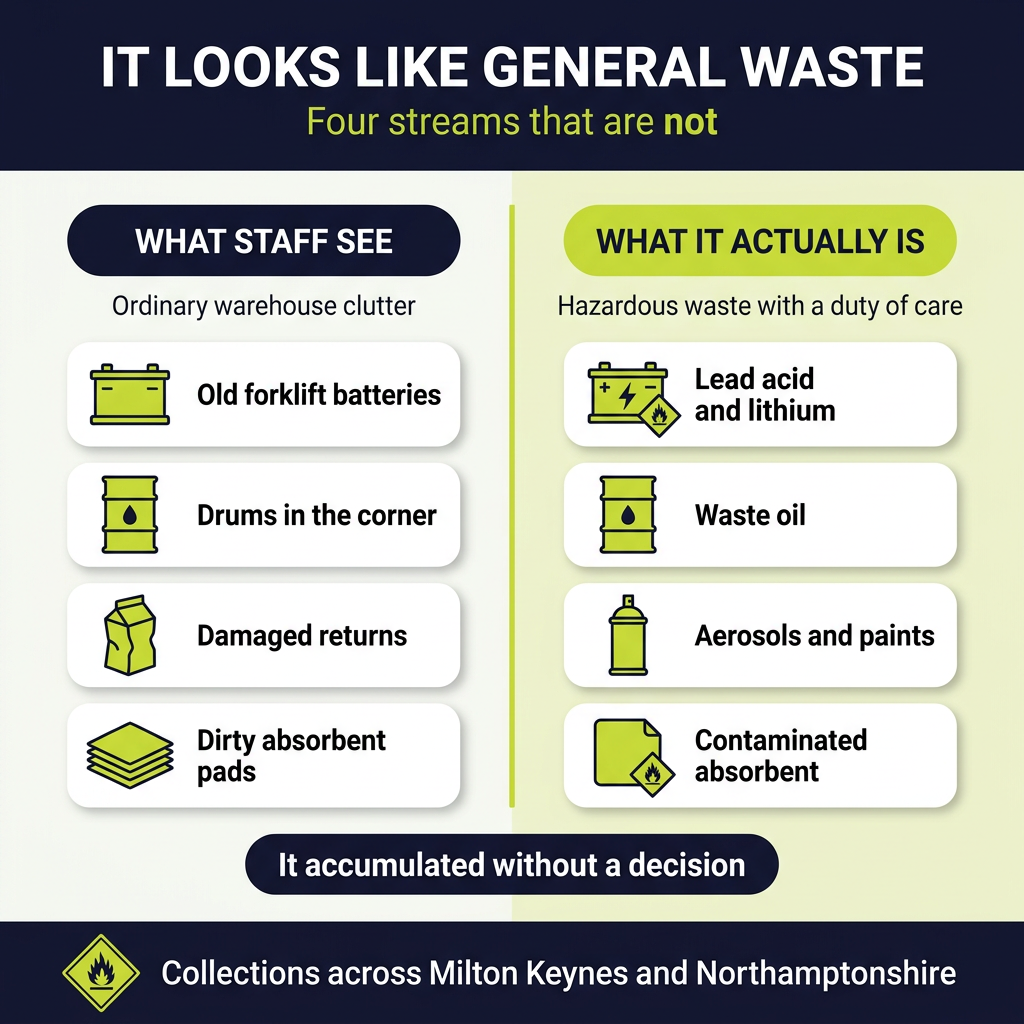
That is hazardous waste. It accumulated without a decision, which is exactly why nobody owns it.
What a Milton Keynes warehouse actually generates
The Milton Keynes and Northamptonshire corridor runs on sheds. Magna Park, Brackmills, Crick, Kingston, Wellingborough and the rest.
The waste streams repeat from site to site.
- Forklift and pallet truck batteries, lead-acid and lithium
- Hydraulic oil, gear oil and used filters from MHE servicing
- Damaged and returned stock, especially aerosols, cleaners and paints
- Used spill kits and contaminated absorbent
- Floor scrubber detergent and its residues
- Fluorescent tubes and emergency lighting cells
- Workshop consumables: brake cleaner, adhesives, sealants
None of those arrives as a delivery of hazardous waste. They arrive as normal operational life, one pallet at a time.
Damaged and returned stock is the one people miss
Returns processing is where this bites hardest, and it is growing.
A returns line receives consumer goods in unknown condition. Aerosols with missing caps, leaking cleaning products, damaged battery packs, paint tins with split lids.
None of that can go in the general waste compactor. It counts as hazardous by composition, whatever the retail label says.
It also cannot go back on the shelf. Once packaging integrity is gone, the item is waste.
The practical answer is a segregated quarantine point on the returns line itself. Get it sorted where it lands, rather than letting a pallet drift to the back of the yard.
Forklift batteries, and the lithium problem
Every shed has batteries, and the risk profile changed when lithium arrived.
Lead-acid is well understood. It is heavy, it contains sulphuric acid, and it must stay upright. Never stack it loose, and expect damaged cells to leak.
Lithium is a different category. A damaged or swollen pack can go into thermal runaway. That is a fire that brings its own oxygen and shrugs off a normal extinguisher.
Swollen means stop. A bulging pack is not a storage problem; it is an urgent one.
Keep suspect cells away from the building, in a non-combustible container. Book them for battery collection rather than holding them until a convenient date.
We cover the lithium storage rules in more depth in our separate guide to waste batteries.
Oil, and the fact that it is worth something
MHE servicing produces waste oil, and waste oil is the one hazardous stream that is genuinely a resource.
It still carries a hazard classification. It still needs a consignment note, a licensed carrier and correct storage.
Store it bunded and covered. Rainwater in a waste oil drum turns a recoverable oil into a contaminated mixture that costs more to handle.
Keep it separate from everything else. Oil mixed with solvent, coolant or brake fluid is no longer a clean oil stream.
Our waste oil service covers the collection side, and we have written about it at length for garages and fleets.
Used spill kits are hazardous waste
This one surprises people every time, so it is worth stating plainly.
An absorbent pad that has soaked up a hazardous liquid takes on the hazard of that liquid. A clean spill kit is a consumable. A used one counts as hazardous waste.
Do not put it in the general waste. That is a duty of care failure with a paper trail leading back to you.
Bag and label it at the point of use, noting what it absorbed. Then book it with the rest.
Our guide to spill response covers the first twelve minutes, which is where most of the damage happens.
Storing it between collections
Sheds have the space to do this properly, which puts them ahead of most sites. The trouble is that space is exactly what lets a problem sit unsolved for a year.
Give it a defined location. A marked bay beats an informal corner.
Bund the liquids. Secondary containment sized for the biggest container plus a margin.
Segregate by class. Acids away from alkalis, oxidisers away from fuels and solvents, batteries in their own area.
Keep it under cover and off the traffic route. Forklifts and drums are a bad mix.
Name an owner. A shed with no named person responsible for the hazardous bay always has the worst hazardous bay.
We supply storage and containment where the current setup will not do.
The audit question
Sooner or later somebody asks for your records. An insurer, a customer running a supply chain audit, or the Environment Agency.
Keep your consignment notes. They are your evidence that the waste left legally and went somewhere licensed.
Keep them findable. A folder nobody can locate is the same as no folder at the moment it matters.
Check your carrier’s licence. It is a public register, and checking takes a minute.
A shed that can produce its paperwork inside ten minutes has a very different audit from one that cannot.
Small volumes and multiple sites
Two situations come up constantly in this corridor.
A little of everything. Some sites produce modest quantities across several streams, which does not justify a tanker. A Haz Box handles exactly this, and it keeps the paperwork simple.
Several sheds under one operator. 3PLs and multi-site operators end up with different arrangements at each site, which makes records a nightmare at audit.
One carrier across all sites gives you consistent paperwork and a single point to ask. That matters more the more sites you run.
Aerosols deserve their own line
Sheds accumulate aerosols faster than anything else, and they are the stream most often binned by mistake.
A part-full aerosol is hazardous waste. It holds propellant under pressure and usually a flammable product.
Never crush them on site unless you hold the permit and the equipment for it.
Never put them in the compactor. A compactor and a pressurised can is a predictable outcome.
Keep them in a rigid container, away from heat, and book them with the rest.
Frequently asked questions
Do you collect hazardous waste in Milton Keynes?
Yes, across Milton Keynes, Northampton, Daventry, Wellingborough and the surrounding industrial estates.
We collect on our own vehicles from our Bedford base, a short run up the A421 and the A5.
Is damaged stock hazardous waste?
It depends on what the stock is. Aerosols, paints, cleaning chemicals, adhesives and battery-containing goods usually are.
Damaged packaging does not change the contents. Segregate returns where you find them rather than letting the pallet grow.
How should we store forklift batteries before collection?
Upright, on a bunded and acid-resistant surface, out of traffic routes and not stacked loose.
Treat swollen or damaged lithium packs as urgent. Keep them away from the building in a non-combustible container and book collection promptly.
Are used spill kits hazardous waste?
Yes, if they have absorbed a hazardous substance. The absorbent takes on the hazard of what it soaked up.
Bag it and label it with what it absorbed. Bag it with your other hazardous waste rather than putting it in general waste.
We produce small amounts across several streams. Is that worth a collection?
Yes. That pattern is common, and it is what the Haz Box exists for.
Tell us what the streams are and how much accumulates. We will tell you which route costs less over a year.
The bottom line
A warehouse produces hazardous waste without ever feeling like a chemical site. Batteries, oil, damaged stock and used absorbent do it quietly.
Sort returns where they land rather than letting the pallet grow at the back of the yard.
Treat swollen lithium as urgent and keep waste oil clean and dry. Remember that a used spill kit is regulated waste.
Then give the hazardous bay a named owner, because that single decision does more than any container you can buy.
Priority HAZ collects across Milton Keynes and Northamptonshire on our own fleet, from small vans to HGVs and hi-abs. Waste carrier and broker licence: CBDU258345.
Request a quote and tell us what is on the pallet at the back.

