
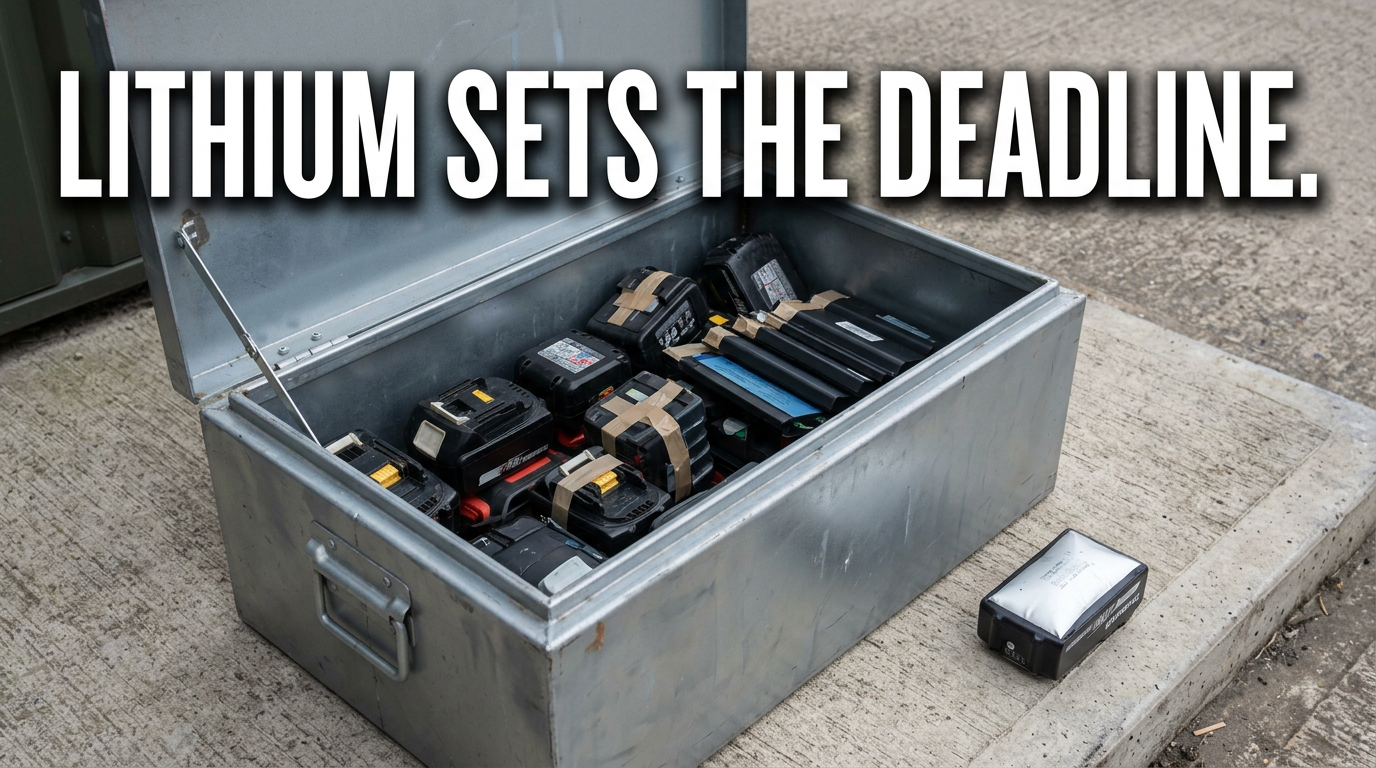
Most hazardous waste sits still and waits for you.
A drum of solvent behaves the same on a Tuesday as it did in March. It is dangerous in a predictable way, and predictable is manageable.
A damaged lithium cell is not like that. It holds its own energy, and it decides when to release it.
Why lithium is a different category
Thermal runaway is the reason, and it is worth understanding rather than just fearing.
A damaged or faulty lithium cell can heat from within. That heat damages more of the cell, which produces more heat, and the loop accelerates.
It brings its own oxygen. That is why smothering does not work the way it does on a normal fire.
It can reignite hours later, after everyone has decided the incident is over.
It spreads to neighbouring cells, which is why a pallet is worse than one pack.
None of that makes lithium unmanageable. It makes the storage and the timing matter far more than they do for anything else you hold.
What counts, and it is more than you think
Businesses tend to picture EV packs. The everyday items are what build up.
- Power tool packs from maintenance and facilities teams
- Laptops, tablets, phones and their spares from IT refreshes
- E-bike and e-scooter batteries, including staff and fleet units
- Disposable vapes collected from site bins and confiscations
- Emergency lighting and UPS cells
- Forklift and pallet truck lithium packs
- Battery-containing goods in damaged or returned stock
All of those become waste batteries when they stop being useful. They carry obligations under the waste battery regime, and under dangerous goods rules in transit.
Damaged, defective and recalled is its own class
This is the distinction most sites have never been told about.
A sound battery at the end of its life is a routine waste stream. Transport rules treat a damaged or defective battery far more strictly, because the risk profile differs.
What puts a cell in that group:
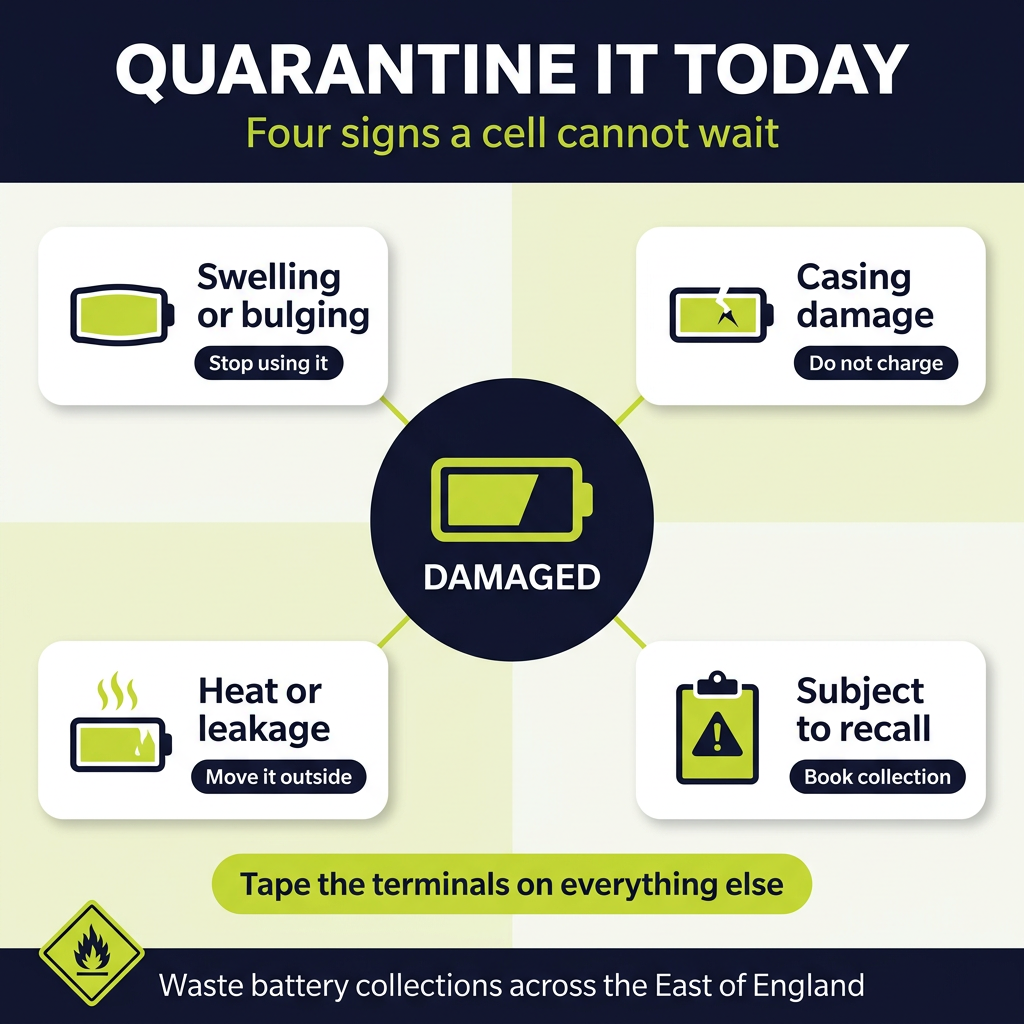
- Swelling or bulging
- Casing damage, crushing or puncture
- Signs of heat, discolouration or leakage
- Part of a manufacturer recall
- Exposure to fire or water
Why it matters to you. These need specific packaging and handling. They should not sit in a normal battery bin waiting for the next collection.
If you find one, that is the day to deal with it.
How to store waste batteries properly
Six things. None cost much, and together they do most of the work.
Tape the terminals. Short circuits across loose terminals are the most common ignition source in a battery bin. Insulating tape on the contacts is cheap insurance.
Use a non-combustible container. Metal or a purpose-made battery container, with a lid. Not a cardboard box, not an open tote.
Segregate the chemistries. Lithium separate from lead-acid, alkaline and nickel types. They fail differently.
Quarantine the damaged ones. Separate container, separate location, outside and away from the building where you can. Sand or vermiculite is a useful medium.
Keep the quantity down. A small bin emptied often beats a large one emptied rarely. The pile is the risk.
Keep it away from what burns. Not next to the cardboard bales, the packaging store or the loading dock.
Where a site needs something better than a repurposed bin, we supply storage and containment built for the job.
Why the pile is the problem on East of England sites
There is a pattern we see repeatedly on sites across Cambridgeshire, Hertfordshire and Essex.
Batteries accumulate because nobody wants to pay for the collection of a half-full bin. So the bin fills, then overflows into a second bin, then a pallet.
Risk scales with quantity, and it does not scale gently. One failing cell in a small bin is an incident. One failing cell in a pallet is a building fire.
The economics feel like they push towards waiting. The risk pushes the other way, and the risk is the one that ends badly.
Book on the calendar rather than on fullness. It is a smaller decision than it feels.
Getting them off-site legally
Waste batteries are hazardous waste and, on the road, usually dangerous goods.
You need a consignment note and a licensed carrier. You keep your copy as your record.
Transport rules apply too, with damaged and defective cells subject to stricter provisions. We set out how the two regimes interact in our piece on ADR and hazardous waste.
Packaging has to carry approval marking. An unmarked container does not qualify, whatever it is made of.
Tell your carrier what you have before they arrive. Quantity, chemistry, and whether anything shows damage. That decides the vehicle and the packaging they bring.
Our battery recycling service covers collection, and we can supply the containers to hold them in the meantime.
What happens to them after collection
People ask, and it is a fair question given what they have just been told to worry about.
Batteries go for treatment and material recovery rather than disposal. Lead-acid recycling is long established and highly effective.
Lithium recovery is younger but growing, and it targets cobalt, nickel, lithium and copper.
That is the point of separate collection. A battery in the general waste stream recovers nothing and risks a fire at the transfer station.
A five-minute policy that works
Most sites do not need a document. They need four rules on a laminated card by the bin.
- Tape the terminals before it goes in
- Anything swollen, hot, leaking or damaged does not go in this bin; it goes to quarantine
- The bin gets booked when it reaches half full, not when it overflows
- One named person owns this bin
That last one matters as much as the other three together.
The insurance angle
Worth raising because it lands on a different desk from waste.
Insurers have grown sharply more interested in lithium storage over the last few years. Some now ask about it directly at renewal.
What they tend to want. A defined storage location, non-combustible containment, quantity limits, and separation from the main building.
What a claim can turn on. Whether you followed your own stated procedure, and whether the quantity on site matched what you declared.
A short written procedure and a booking record cover most of that. It is a cheap piece of paper to hold.
Frequently asked questions
Do you collect waste batteries across the East of England?
Yes. We collect batteries across Cambridgeshire, Bedfordshire, Hertfordshire, Essex, Norfolk and Suffolk, and more widely across mainland UK.
We run our own vehicles from our Bedford base rather than brokering the work.
What do I do with a lithium battery that has swollen?
Treat it as urgent. Move it away from the building into a non-combustible container, well clear of anything that burns. Then book collection promptly.
Do not put it in the normal battery bin. Do not leave it until the next scheduled pickup.
Do I need to tape battery terminals?
Yes, it is one of the simplest risk reductions available. Exposed terminals touching each other or a metal container can short and ignite.
Insulating tape over the contacts takes seconds and prevents the most common cause of bin fires.
Are disposable vapes hazardous waste?
Yes. They contain a lithium cell and usually residual nicotine liquid, so they cannot go in general waste.
Collect them on their own in a lidded, non-combustible container, then bag them with your other battery waste.
Can waste batteries go in general recycling?
No. Batteries in mixed recycling are a known cause of fires at waste transfer and recycling sites.
They need separate collection as hazardous waste, with a consignment note and a licensed carrier.
The bottom line
Lithium is the one waste stream that sets its own deadline. Everything else waits for your schedule.
Tape the terminals, use a lidded metal container, and segregate the chemistries.
Quarantine anything swollen, damaged or recalled the day you find it.
Then book on the calendar rather than on fullness, because the pile is the risk.
Priority HAZ collects waste batteries across the East of England and mainland UK on our own fleet. Waste carrier and broker licence CBDU258345.
Request a quote or tell us what is in the bin, and say straight away if anything is swollen.

