
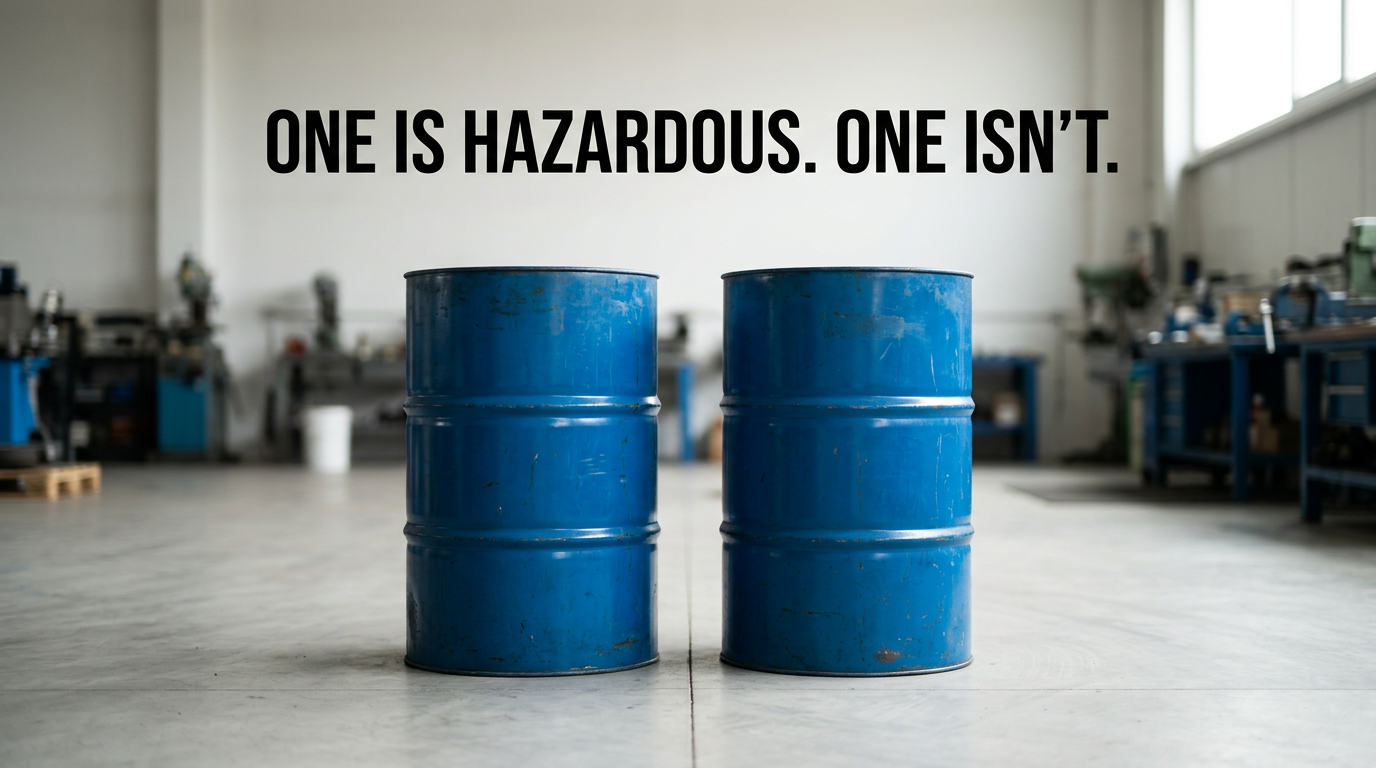
Two identical-looking drums of waste coolant sit on a factory floor. One is legally hazardous. One is not.
Nothing about the outside tells you which. The difference is what is dissolved in them and at what concentration, and getting that judgement wrong changes the paperwork, the carrier, the disposal route and the cost.
Here is how classification actually works, without the acronyms getting in the way.
The classification is your job, not your contractor’s
This is the part that surprises people. Under UK law, the waste holder has the duty to classify the waste correctly. That is you, the business producing it.
Your waste contractor will help, and a good one will help a great deal. But if a load is misclassified, the regulator comes to the producer first. “Our supplier told us it was fine” is not a defence, because the duty was never theirs to discharge.
So it is worth understanding the logic even if somebody else does the legwork.
Two documents run the whole system
The List of Waste is a catalogue of six-digit codes covering every type of waste, usually still called EWC codes. Every waste that leaves your site gets one.
WM3 is the technical guidance that tells you how to apply that list. It is published jointly by the Environment Agency, SEPA, Natural Resources Wales and the Northern Ireland Environment Agency, so it applies across the UK.
Between them, those two give any waste one of three outcomes.
Absolute, mirror, or non-hazardous
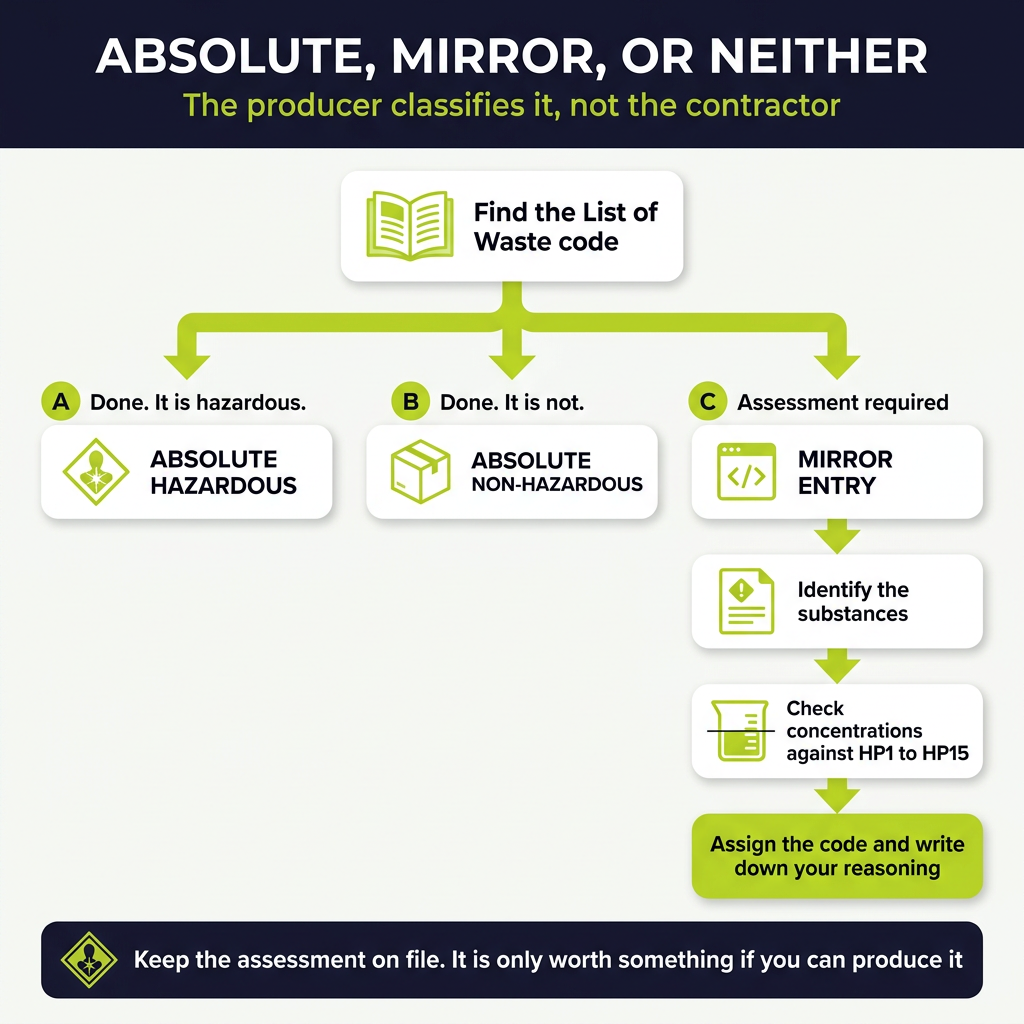
Absolute hazardous entries are hazardous full stop, no assessment needed. Waste oil, asbestos, solvent residues and lead-acid batteries sit here. The code carries an asterisk and the decision is already made for you.
Absolute non-hazardous entries work the same way in reverse. Cardboard is cardboard.
Mirror entries are where the work is. These are pairs of codes for the same material, one hazardous and one not, and which one applies depends on what is actually in your particular waste.
A mirror entry looks like this in practice. The same type of waste has two codes sitting next to each other on the list. One is flagged as hazardous “containing dangerous substances”; the other is flagged “other than those mentioned”. You have to decide which describes your drum.
That decision is not optional, and it is not a guess. It is an assessment you are legally required to make and to be able to justify.
HP1 to HP15, the fifteen hazard properties
A waste is hazardous if it shows one or more of fifteen hazardous properties, numbered HP1 to HP15. They come from EU Regulation 1357/2014 and were retained in UK law.
In plain terms, they cover:
- Explosive, oxidising and flammable
- Irritant to skin and eyes, and specific target organ toxicity
- Acute toxicity
- Carcinogenic, mutagenic and toxic for reproduction
- Corrosive
- Infectious
- Release of toxic gas on contact with water or acid
- Sensitising
- Ecotoxic
- Capable of producing another hazardous waste after disposal
A single waste can carry several of these at once. Waste solvent is routinely flammable, irritant and ecotoxic simultaneously.
How the assessment actually runs
For an absolute entry, you are done at step one. For a mirror entry, the process is:
- Identify what is in it. Not “paint waste“, but which paints, which solvents, which additives. Safety data sheets for the input products are the starting point, because the hazards of the inputs usually carry into the waste.
- Work out the concentrations. How much of each substance, as a percentage.
- Compare against the thresholds. WM3 sets concentration limits for each hazardous property. Below the threshold for every property, the waste is non-hazardous. At or above any one of them, it is hazardous.
- Assign the code and the HP properties, and write down your reasoning.
That fourth step matters more than people expect. The assessment is only worth anything if you can produce it later. Keep the safety data sheets, the calculation and the conclusion on file with the consignment notes.
When you genuinely cannot tell
Sometimes the inputs are unknown. An unlabelled drum in the corner of a workshop nobody can identify. A cabinet of decanted chemicals inherited from a previous occupier. A tank whose contents have not been recorded for a decade.
In that situation, the honest answer is that you cannot classify it from a desk, and you should not try. Sampling and laboratory analysis are the route, and it exists precisely for this. A sample is taken safely, analysed, and the result gives you a defensible classification.
It costs less than most people assume, and considerably less than a rejected load or a misdeclared consignment.
Until it is identified, treat an unknown as hazardous. That is the safe default for storage and segregation, and it is what a regulator would expect to see.
Four places classification quietly goes wrong
Assuming dilution declassifies something. Diluting a hazardous waste to get under a threshold is generally an offence, not a compliance strategy.
Copying last year’s code. Processes change, suppliers change, formulations change. A code that was right in 2023 may not describe what is in the drum now.
Classifying the container instead of the contents. An empty drum that held a hazardous substance is usually still hazardous until it is properly cleaned.
Letting mixed waste inherit the worst code by accident. Tip a small amount of hazardous waste into a large container of non-hazardous waste, and you have not diluted the problem. You have made the whole container hazardous, and made it far more expensive.
Frequently asked questions
Who is responsible for classifying hazardous waste?
The waste holder, which means the business producing the waste. Your contractor can advise and most good ones will, but the legal duty to classify correctly sits with the producer. If a load is misclassified, the regulator approaches the producer first.
What is a mirror entry in waste classification?
A mirror entry is a pair of codes on the List of Waste covering the same type of waste, one hazardous and one non-hazardous. Which applies depends on what your specific waste contains and at what concentration. You must assess it against the HP1 to HP15 hazard properties and be able to justify the conclusion you reach.
What are HP codes?
HP1 to HP15 are the fifteen hazardous properties used to decide whether a waste is hazardous, covering things like explosive, flammable, corrosive, toxic, carcinogenic and ecotoxic. A waste displaying one or more of them at or above the relevant concentration threshold is hazardous. One waste can show several properties at the same time.
How do I classify an unlabelled drum?
You cannot classify it reliably from a desk. Have it sampled and analysed by a competent chemist, which gives you a defensible classification and the correct code. Until then, store and handle it as hazardous, keep it segregated, and do not attempt to open or mix it.
What records do I need to keep for waste classification?
Keep the safety data sheets for the inputs, the assessment or analysis result, the reasoning behind the code you assigned, and the consignment notes. Hazardous waste consignment notes must be kept for at least three years. The assessment is only useful if you can produce it when asked.
The bottom line
Most hazardous waste problems are classification problems wearing a different coat. The load gets rejected, the invoice gets queried, the inspector asks a question, and it all traces back to a code somebody assigned without an assessment behind it.
If it is an absolute entry, the decision is made for you. If it is a mirror entry, do the assessment and keep it. If you genuinely do not know what is in the drum, get it analysed rather than guessing.
Priority HAZ classifies, samples and collects hazardous waste for businesses across mainland UK, with chemist sampling and analysis for unknowns and full consignment documentation. Request a quote, and we will work through the classification with you.

